ASRS vs Traditional Warehouse Systems: Cost, ROI, and Performance Comparison for Industrial Buyers
Summary
Traditional warehouse systems rely heavily on manual labor, forklifts, and static shelving structures, which limit efficiency, scalability, and accuracy.
ASRS (Automated Storage and Retrieval Systems) introduces a fully automated, data-driven warehouse architecture that significantly improves storage density, operational speed, and long-term ROI.
This article provides a structured comparison between ASRS and traditional warehouse systems from cost, performance, and return on investment perspectives.
Technology
- Two warehouse models compared in this case:
- Traditional Warehouse Technology:
- Manual Forklift Handling System
- Static Pallet Racking System
- Paper or Basic Digital Inventory System
- Manual Picking & Sorting Operations
- Limited Warehouse Management System (if any)
- ASRS Warehouse Technology:
- Stacker Crane Automated Storage System
- High-Density Vertical Storage Racking
- WMS (Warehouse Management System)
- AGV / AMR Transport Systems
- Conveyor Automation System
- RFID / Barcode Tracking System
- Real-Time Inventory Database
- ERP / MES Integration Capability
Challenge
Industrial buyers evaluating warehouse systems face several key challenges:
High Initial Investment Uncertainty
ASRS requires upfront capital but promises long-term ROI.
Lack of Clear Performance Benchmarking
Difficult to compare automation vs manual systems objectively.
Labor Cost Pressure
Traditional warehouses depend heavily on human workforce.
Space Utilization Inefficiency
Static racking systems waste vertical warehouse space.
Scalability Limitations
Traditional systems struggle with growing order volume.
Risk of Operational Errors
Manual handling increases picking and inventory mistakes.
Solution
ASRS solves these structural inefficiencies through automation:
Fully Automated Storage & Retrieval
Eliminates forklift dependency.
Intelligent Inventory Management
Real-time tracking via WMS.
High-Density Vertical Design
Maximizes storage capacity per square meter.
Integrated Transport Systems
AGV + conveyor automation reduces manual movement.
Data-Driven Warehouse Operations
ERP/WMS integration improves decision-making.
Workflow & Layout
Comparison of workflows:
Traditional Warehouse Workflow:
Manual receiving
Forklift storage
Paper-based inventory tracking
Manual picking
Manual packing and dispatch
ASRS Workflow:
Automated receiving & scanning
System-assigned storage location
Real-time WMS inventory update
Automated retrieval via stacker crane
Conveyor + AGV transport
Automated dispatch
Results & ROI
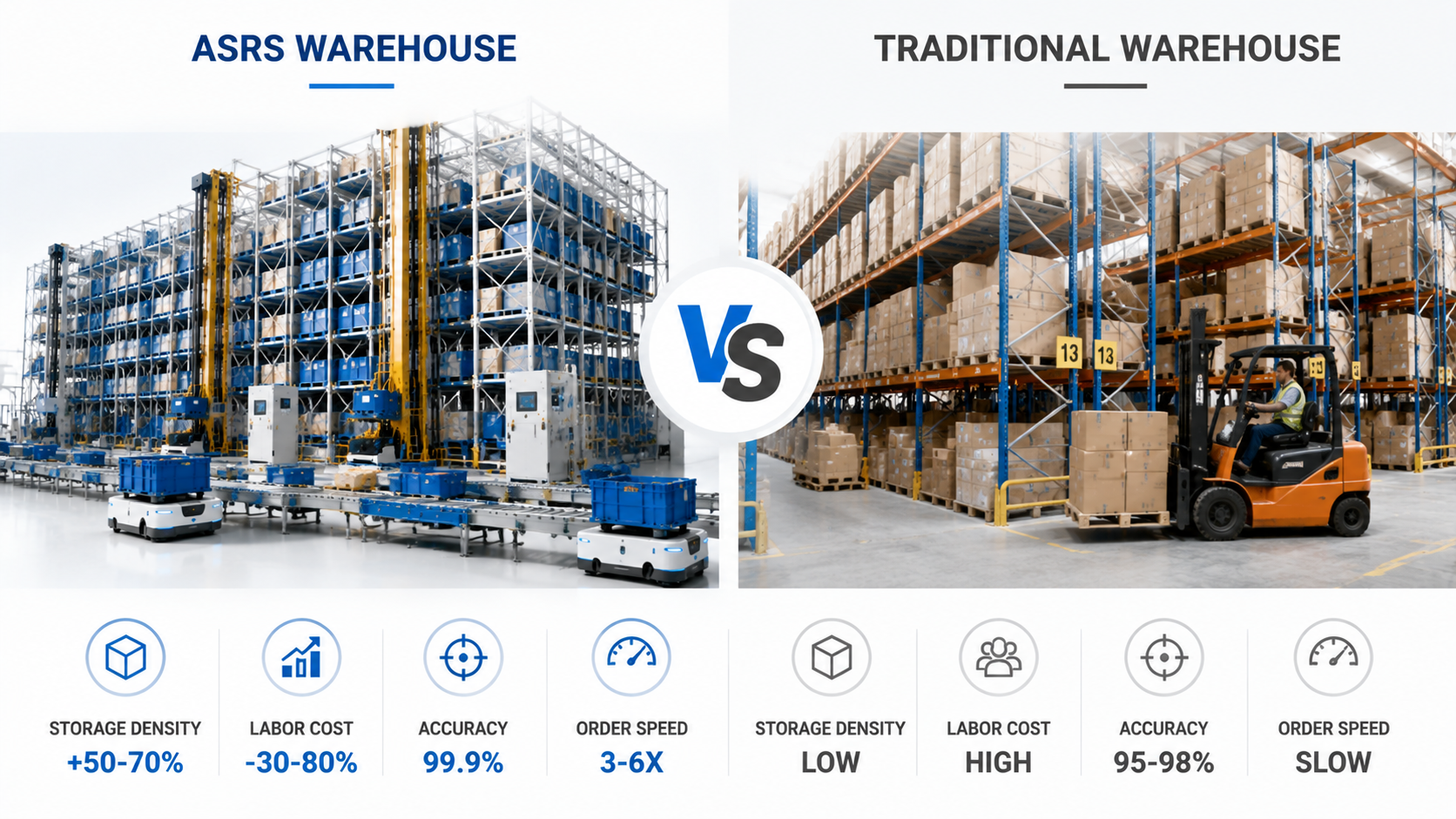
- Performance comparison:
- Storage Efficiency Improvement: +40% to +70% (ASRS)
- Labor Cost Reduction: 30% – 80%
- Picking Accuracy: up to 99.9% (ASRS) vs 95%–98% (manual)
- Order Processing Speed: 3x – 6x faster
- Space Utilization: +50% vertical usage
- ROI Payback Period:
- Traditional warehouse: no ROI improvement
- ASRS: 2 – 4 years
Equipment List
- Traditional warehouse:
- Forklifts
- Pallet racks
- Manual scanners
- Basic shelving systems
- ASRS warehouse:
- Stacker Crane System
- Automated Racking System
- WMS Software Platform
- AGV / AMR Robots
- Conveyor System
- RFID / Barcode System
- Control Cabinets (PLC Systems)
- Sorting & Buffer Stations
- ERP Integration Interface
- Safety Monitoring Systems
Project Overview / Opening
Warehouse automation has become a strategic decision for industrial buyers facing rising labor costs and increasing supply chain complexity.
While traditional warehouses rely on manual operations and static infrastructure, ASRS introduces a fully automated, intelligent, and scalable system designed for modern logistics demands.
This case study compares both systems to help decision-makers understand the real operational and financial impact of warehouse automation.
Key Points
- ASRS replaces manual labor with automated systems
- Warehouse performance is directly linked to storage density
- WMS is the core intelligence layer in ASRS systems
- Traditional warehouses are limited in scalability
- ASRS delivers measurable ROI through efficiency gains
- Automation reduces long-term operational risk
Implementation / Workflow
Implementation comparison:
Traditional Warehouse:
Basic layout planning
Rack installation
Forklift deployment
Manual training
Operation start
ASRS Warehouse:
Demand & throughput analysis
System design & simulation
Equipment manufacturing
Software integration (WMS/ERP)
Installation & commissioning
Full automation deployment
Customer Value / Results
Industrial buyers gain the following value from ASRS adoption:
Significant long-term labor cost reduction
Higher warehouse productivity and throughput
Improved inventory accuracy and traceability
Strong scalability for business growth
Reduced operational dependency on manual labor
Enhanced competitiveness in global supply chains
Conclusion / Next Step
ASRS represents the next generation of warehouse infrastructure, offering significant advantages over traditional manual warehouse systems in cost efficiency, performance, and scalability.
For industrial buyers planning long-term warehouse transformation, ASRS is not just an upgrade—it is a strategic shift toward intelligent logistics.
Related Blog
Start with Your Business Challenge
Tell us about your warehouse, factory, or production requirements. We'll help you explore practical automation solutions and relevant project references.