
How to Build an Automated High Frequency Transformer Factory for High-Volume Production
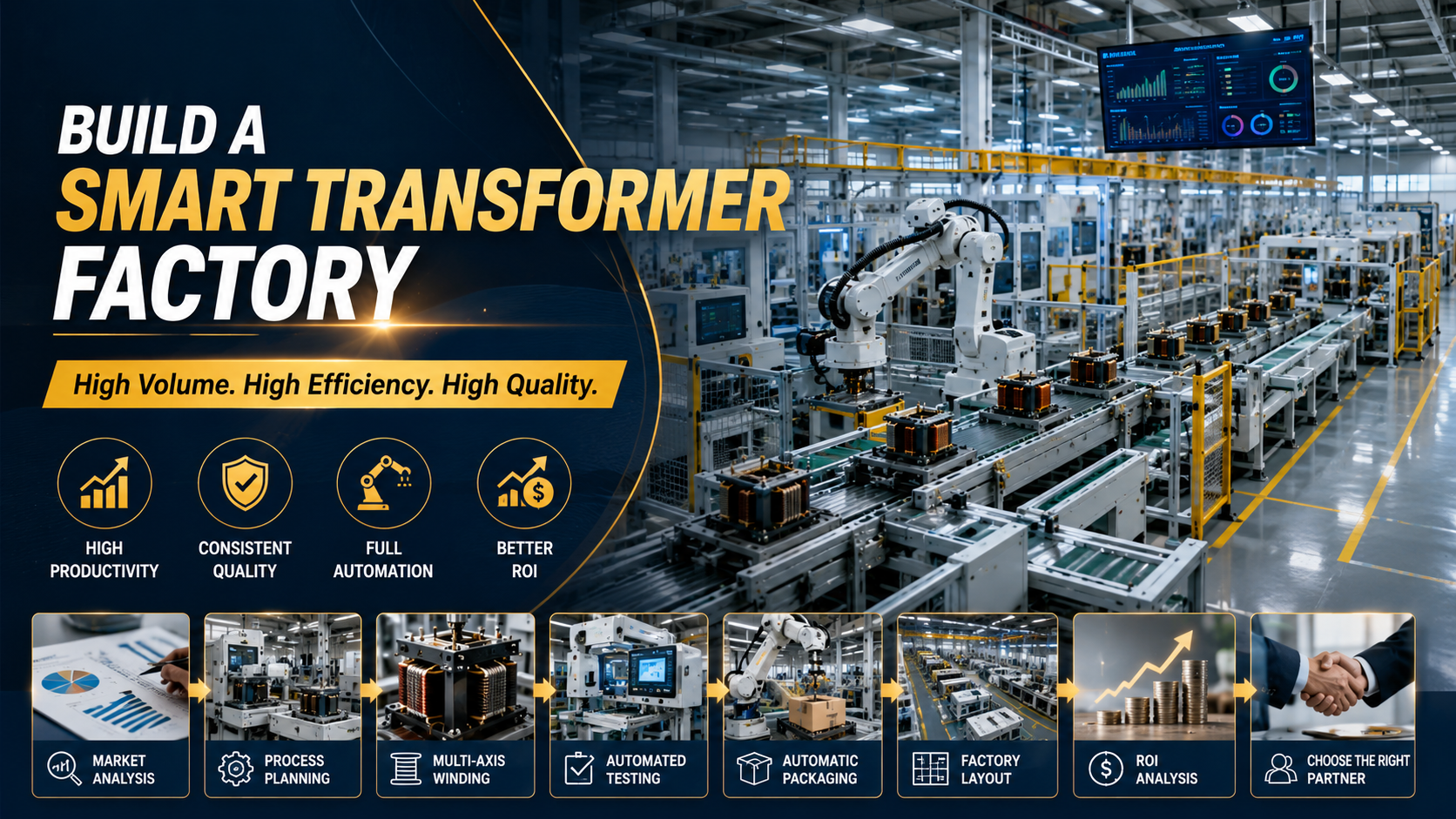
Summary
As demand for electric vehicles, renewable energy systems, AI servers, industrial power supplies, and energy storage continues to grow, manufacturers are under increasing pressure to expand transformer production while maintaining consistent quality and competitive costs.
Building a modern high frequency transformer factory is no longer about purchasing individual machines. Success depends on designing an integrated production system that combines intelligent manufacturing, automated material handling, quality control, and scalable production planning.
This guide explains how manufacturers can plan an automated transformer factory capable of supporting long-term growth, higher productivity, and lower manufacturing costs.
Technology
- High Frequency Transformer Manufacturing
- Multi-Axis Automatic Winding
- Automated Material Feeding
- Transformer Core Assembly
- Precision Soldering
- Vision Inspection System
- Electrical Performance Testing
- Automatic Packaging
- Conveyor Automation
- Smart Factory Integration
- MES Integration (Optional)
- Factory Layout Planning
Challenge
The global market for high frequency transformers is expanding rapidly due to growing demand from electric vehicles, renewable energy systems, industrial electronics, AI infrastructure, and fast-charging technologies.
However, many manufacturers still rely heavily on manual production methods, leading to several operational challenges:
Rising labor costs and skilled worker shortages
Limited production capacity
Inconsistent winding quality
Higher defect and rework rates
Difficult quality traceability
Inefficient factory layouts
Increasing delivery pressure from customers
As production volumes continue to grow, simply hiring more operators is no longer a sustainable solution. Manufacturers need automation that increases capacity while maintaining stable product quality.
Solution
A modern transformer factory should be designed as an integrated manufacturing system rather than a collection of standalone machines.
Instead of optimizing one workstation at a time, manufacturers should plan the entire production workflow from raw material feeding to final inspection and packaging.
An automated production line typically combines intelligent material handling, multi-axis winding technology, automated assembly, electrical testing, visual inspection, and digital production management into one coordinated manufacturing process.
This integrated approach not only improves productivity but also provides greater flexibility for future capacity expansion.
Workflow & Layout
Raw Material Storage
↓
Automatic Material Feeding
↓
Multi-Axis Winding
↓
Wire Processing
↓
Core Assembly
↓
Automatic Soldering
↓
Glue Dispensing
↓
Electrical Testing
↓
Vision Inspection
↓
Laser Marking (Optional)
↓
Automatic Sorting
↓
Packaging
↓
Finished Goods Warehouse
A well-designed factory layout minimizes unnecessary material movement, balances production capacity between stations, and supports continuous manufacturing while allowing future production expansion.
Results & ROI
- Manufacturers investing in factory automation commonly achieve:
- 2–5× higher production capacity
- Significant labor cost reduction
- Improved winding consistency
- Lower defect rates
- Stable production quality
- Better production traceability
- Shorter delivery times
- Faster response to customer demand
- Scalable production for future growth
- While every project differs
- automation investments often provide long-term competitive advantages through higher efficiency and reduced operating costs.
Equipment List
- A complete automated high frequency transformer factory may include:
- Automatic Material Feeding System
- Multi-Axis Winding Machines
- Wire Cutting & Terminal Processing Equipment
- Transformer Core Assembly Stations
- Automatic Soldering System
- Glue Dispensing System
- Electrical Testing Equipment
- Vision Inspection System
- Laser Marking Machine (Optional)
- Automatic Sorting System
- Packaging Line
- Conveyor & Transfer System
- MES / ERP Integration (Optional)
- Warehouse Automation (Optional)
Project Overview / Opening
Building a competitive transformer manufacturing facility requires more than purchasing advanced equipment. Manufacturers must design a production system capable of supporting consistent quality, scalable output, and efficient factory operations.
Today's leading transformer factories are increasingly adopting intelligent automation to replace repetitive manual work while improving product consistency and reducing operational costs.
From production planning and factory layout to equipment integration and quality control, every stage of the manufacturing process should be designed with long-term productivity in mind.
Key Points
- 📌 Understand future market demand before defining production capacity.
- 📌 Design the factory around manufacturing workflow rather than individual machines.
- 📌 Use multi-axis winding technology to improve speed and consistency.
- 📌 Integrate automatic inspection to reduce quality variation.
- 📌 Plan flexible layouts for future product expansion.
- 📌 Balance automation investment with expected production volume.
- 📌 Build a digital production environment for better traceability.
- 📌 Choose suppliers capable of providing complete project integration instead of isolated equipment.
Implementation / Workflow
A successful transformer factory project usually begins with production capacity analysis and product evaluation.
Engineers then design the factory layout based on material flow, production rhythm, and equipment integration requirements.
Multi-axis winding systems form the core of the production process, followed by automated assembly, soldering, electrical testing, visual inspection, and packaging.
Throughout the project, manufacturers should also consider future expansion, maintenance accessibility, digital production management, and integration with warehouse logistics to maximize long-term manufacturing efficiency.
Customer Value / Results
Factory owners and investors benefit from automation in several important ways:
Higher manufacturing capacity without proportional labor increases
Stable product quality that supports global customer requirements
Lower production costs over the factory's lifecycle
Faster order fulfillment
Better utilization of production space
Improved manufacturing flexibility
Stronger competitiveness in international markets
Easier expansion as market demand grows
Rather than solving only today's production challenges, automation creates a manufacturing platform capable of supporting future business growth.
Conclusion / Next Step
Building an automated high frequency transformer factory is a strategic investment that requires careful planning, the right production technologies, and experienced project integration. A successful project is not defined by individual machines, but by how efficiently the complete manufacturing system works together to deliver consistent quality, scalable production, and long-term return on investment.
We help manufacturers worldwide design, source, integrate, and deliver industrial automation projects by leveraging China's manufacturing ecosystem. Whether you are planning a new transformer factory, upgrading an existing production line, or evaluating automation opportunities, our team can support you from factory planning and equipment selection to complete system integration and project delivery.
Visit our Contact page to submit your project requirements or inquiry. We will work with you to develop a customized automation solution that matches your production goals, factory layout, and long-term business strategy.
Related Blog
Start with Your Business Challenge
Tell us about your warehouse, factory, or production requirements. We'll help you explore practical automation solutions and relevant project references.