Paper Cup Manufacturing Process Explained: From Paper Roll to Finished Cup
Summary
Millions of disposable paper cups are produced daily for coffee shops, restaurants, takeaway services, beverage companies, and food packaging industries. While the final product appears simple, the manufacturing process behind modern paper cup production is highly automated and requires precise coordination between multiple technologies.
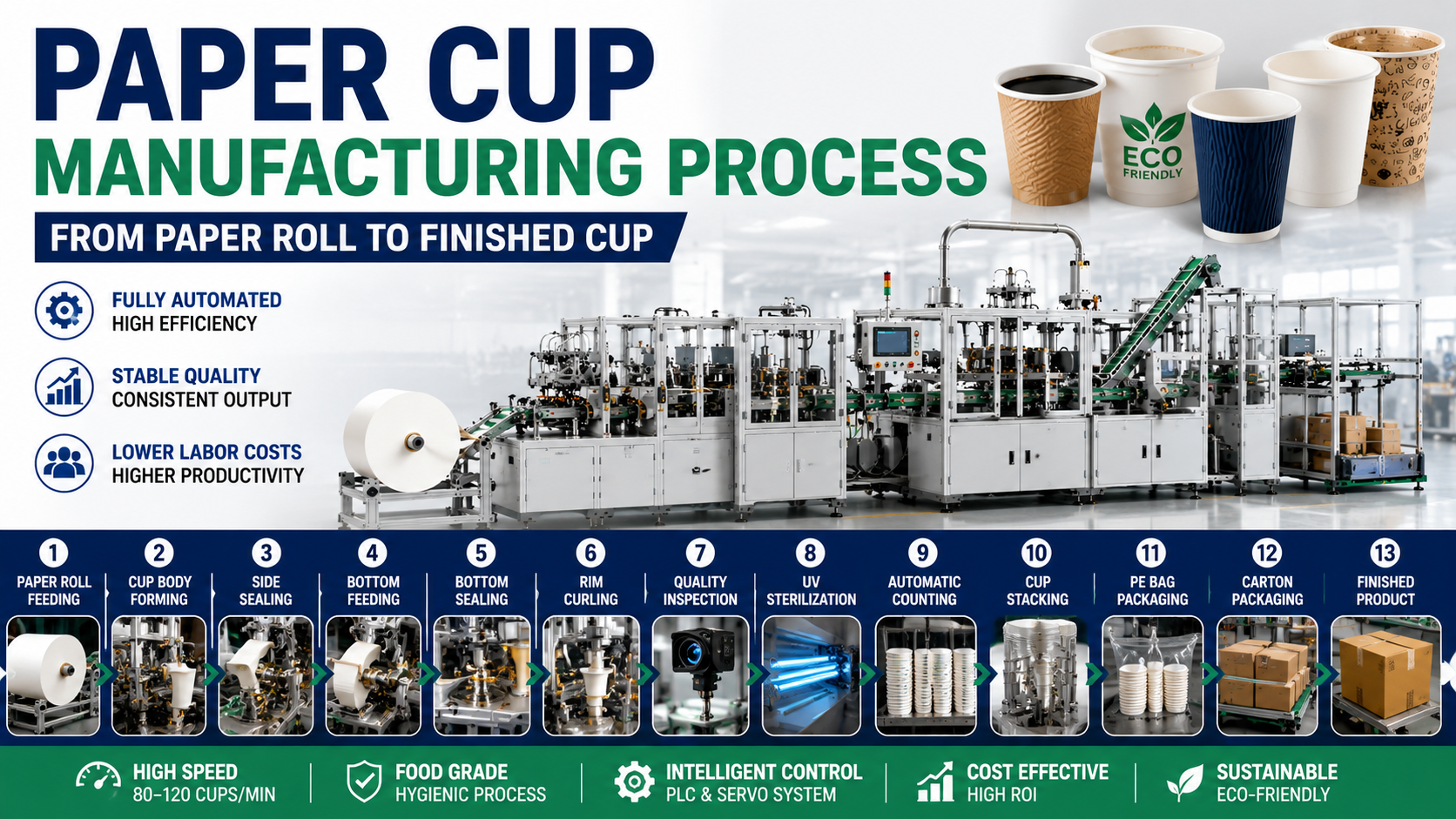
Today's paper cup manufacturing systems integrate material feeding, cup body forming, bottom sealing, rim curling, inspection, sterilization, counting, stacking, and packaging into one continuous process.
Understanding the complete production workflow helps manufacturers improve productivity, reduce defects, optimize factory planning, and evaluate automation investment opportunities.
This article explains every step involved in transforming paper rolls into finished packaged paper cups.
Technology
- Core technologies used throughout paper cup manufacturing:
- PE-coated Paper Roll Feeding Technology
- Servo Motion Control System
- Cup Body Forming Technology
- Bottom Sealing Technology
- Rim Curling Technology
- Heat Sealing Process
- Machine Vision Inspection
- UV Sterilization Technology
- Automatic Counting System
- Intelligent Stacking System
- Automatic Packaging Technology
- PLC Intelligent Control Platform
- Production Data Monitoring
- Smart Factory Integration
Challenge
Paper cup manufacturers commonly face production challenges during manufacturing.
1. Material Waste
Improper material feeding may cause unnecessary waste.
2. Cup Leakage
Poor bottom sealing can lead to leakage problems.
3. Product Deformation
Incorrect forming parameters can reduce product quality.
4. Inconsistent Cup Dimensions
Manual adjustments often create dimensional variations.
5. Production Bottlenecks
Manual operations reduce overall line efficiency.
6. Hygiene Requirements
Food packaging products require strict contamination control.
7. Packaging Inefficiency
Manual packaging limits production output.
Solution
Modern automated production lines solve these challenges through process integration.
Solutions include:
Automatic material feeding
Servo-controlled cup forming
Precision bottom sealing
Automated rim curling
Real-time quality inspection
UV sterilization
Automatic counting
Intelligent packaging
Production monitoring
Workflow & Layout
Complete paper cup manufacturing workflow:
Step 1
PE-coated Paper Roll Feeding
↓
Step 2
Paper Cutting and Feeding
↓
Step 3
Cup Body Forming
↓
Step 4
Cup Side Sealing
↓
Step 5
Bottom Paper Feeding
↓
Step 6
Bottom Sealing
↓
Step 7
Cup Bottom Heating
↓
Step 8
Cup Rim Curling
↓
Step 9
Quality Inspection
↓
Step 10
UV Sterilization
↓
Step 11
Automatic Counting
↓
Step 12
Cup Stacking
↓
Step 13
PE Bag Packaging
↓
Step 14
Carton Packaging
↓
Step 15
Finished Product Output
Results & ROI
- Typical production improvements include:
- Production Efficiency Increase:40–100%
- Labor Reduction:50–80%
- Product Defect Reduction:20–60%
- Material Waste Reduction:10–30%
- Packaging Efficiency Improvement:30–80%
- Production Cost Reduction:15–40%
- Typical ROI:1.5–3 years
Equipment List
- Typical equipment configuration:
- Paper Roll Feeding Unit
- Paper Feeding System
- Cup Forming Machine
- Side Sealing Unit
- Bottom Feeding Module
- Bottom Sealing Unit
- Heating Module
- Rim Curling Unit
- Vision Inspection System
- UV Sterilization Unit
- Counting System
- Stacking Machine
- Packaging Machine
- Conveyor System
- PLC Control Cabinet
- Remote Monitoring System
Project Overview / Opening
How does a flat roll of paper become the coffee cup used every day by millions of people?
Although paper cups appear simple, the manufacturing process involves multiple precise production steps requiring automation, motion control, inspection technologies, and intelligent packaging systems.
As demand for takeaway beverages and food-service products continues growing globally, manufacturers increasingly rely on automated production lines to achieve higher productivity and product quality.
Understanding the complete production process also helps companies identify optimization opportunities and improve long-term operational performance.
Key Points
- 1-Raw Material Feeding
- PE-coated paper rolls serve as the primary raw material.
- The coating layer provides:
- Liquid resistance
- Heat resistance
- Food safety protection
- 2-Cup Body Forming
- The paper material is cut and shaped into cylindrical cup structures.
- High precision forming directly affects:
- Appearance quality
- Structural stability
- Leakage resistance
- 3-Bottom Sealing
- The bottom paper is inserted and sealed through heating technology.
- This process determines:
- Cup strength
- Leakage performance
- Product reliability
- 4-Rim Curling Process
- Rim curling improves:
- User comfort
- Structural strength
- Product appearance
- 5-Automatic Inspection
- Vision systems automatically detect:
- Shape defects
- Missing materials
- Seal failures
- Size deviations
- 6-Packaging Process
- Finished products are automatically:
- Counted
- Stacked
- Bagged
- Packed into cartons
Implementation / Workflow
Typical project implementation steps:
Phase 1Requirement analysis
Phase 2Cup specification confirmation
Phase 3Production capacity planning
Phase 4Factory layout design
Phase 5Equipment manufacturing
Phase 6Automation programming
Phase 7Installation and testing
Phase 8Production startup
Customer Value / Results
Customers gain multiple benefits:
Higher Production EfficiencyContinuous production significantly increases output.
Lower Labor RequirementsAutomation reduces dependence on manual labor.
Better Product QualityConsistent process control improves stability.
Improved Hygiene StandardsSterilization and automated handling reduce contamination risks.
Reduced Manufacturing CostLower waste and higher productivity reduce total cost.
Stronger Market CompetitivenessManufacturers gain advantages through productivity and quality improvements.
Conclusion / Next Step
Paper cup manufacturing has evolved from labor-intensive operations into highly automated smart production systems.
Understanding the complete workflow—from paper roll feeding to finished packaging—helps manufacturers optimize production planning, reduce quality risks, and improve investment decisions.
As demand for food packaging and sustainable products continues growing worldwide, manufacturers adopting intelligent automation technologies will achieve greater production flexibility and long-term competitiveness.
If you are planning a paper cup manufacturing facility or evaluating automation upgrades, our engineering team can help design a customized production solution and estimate project investment requirements.
Related Blog
Start with Your Business Challenge
Tell us about your warehouse, factory, or production requirements. We'll help you explore practical automation solutions and relevant project references.