How a Fully Automated Motor Assembly Line Increased Throughput by 200% – A Smart Factory Case Study
Summary
This smart manufacturing case study examines how a fully automated motor assembly line transformed traditional manual production into an integrated, high-efficiency system. By combining precision assembly stations, vision inspection, automated testing, and intelligent data collection, the project achieved a 200% increase in production throughput, reduced defect rates from 3–5% to under 1%, and cut labor requirements by 60–70%. The system is designed for electric motor, electronic product, and automotive component manufacturing—industries requiring high precision, consistent quality, and reliable traceability.
Technology
- Automated Assembly Systems – Precision assembly stations with servo-driven positioning and torque-controlled fastening for accurate
- repeatable operations
- Vision Inspection Systems – High-resolution cameras with AI-assisted defect detection
- capable of identifying surface scratches or assembly deviations as minute as 0.1mm
- Automated Testing Stations – In-line functional testing with electrical
- insulation resistance
- and mechanical run verification
- all with automated pass/fail data logging
- Product Traceability Management – End-to-end batch tracking with unique product identification codes from component feeding through final packaging
- Intelligent Production Data Collection – Real-time OEE monitoring
- process parameter recording
- and sensor network integration for complete production visibility
- Automated Packaging Line – Integrated cartoning
- labeling
- and palletizing for finished product handling
- Smart Factory Integration – MES connectivity and central production control system enabling data-driven decision-making
Challenge
Traditional motor and electronic product assembly relies heavily on manual labor, creating a range of operational challenges that limit scalability and competitiveness. Manufacturers in this sector face persistent issues that affect both productivity and product quality.
High Labor Dependency – Manual assembly operations require large workforces, leading to rising labor costs and difficulties in recruitment and retention. In today's competitive environment, manufacturers must find ways to reduce labor intensity while maintaining output.
Inconsistent Product Quality – Human error in repetitive assembly tasks results in variable quality and higher defect rates. When manual processes dominate, maintaining consistent quality across thousands of units becomes nearly impossible.
Limited Production Throughput – Manual processes cannot match the speed and consistency of automated systems, constraining output capacity and limiting a manufacturer's ability to respond to market demand.
Quality Control Gaps – Manual inspection methods are subjective and miss defects that automated vision systems would detect. Vision systems can detect surface scratches or assembly deviations as minute as 0.1mm—far beyond human capability.
Lack of Traceability – Without automated data collection, tracking products through production stages is difficult or impossible. In industries where quality records and batch tracking are essential, this creates significant compliance risks.
Inefficient Material Flow – Poorly coordinated manual material handling creates bottlenecks and delays. The complexity of motor assembly lines is a key challenge for manufacturers seeking to improve production efficiency and product quality.
Solution
The solution is a fully integrated automated motor assembly line that combines multiple automation modules into a seamless production system. Each module is designed to address a specific production challenge while working in coordination with the overall system. The process is performed within a fully automated cell that integrates multiple stations and robotic systems.
Automatic Component Feeding – Vibratory bowl feeders and conveyor systems deliver components to assembly stations with consistent timing and orientation, eliminating manual material handling bottlenecks.
Precision Assembly Stations – Servo-driven pick-and-place units with torque-controlled fastening provide accurate and repeatable assembly. Twin electric presses, systems to pick up and heat casings, press-fitting stations, and robots for thermal paste dispensing and component assembly work together in sequence.
Automated Testing and Quality Inspection – In-line functional testing stations verify electrical and mechanical performance of each motor. The system includes screwing and end-of-line testing stations that ensure every product meets specification before proceeding.
Vision Inspection Systems – High-resolution cameras inspect component presence, alignment, and dimensional accuracy at multiple points along the line. Advanced machine vision technology dramatically enhances quality control capabilities.
Product Traceability Management – Unique identification codes track each motor from component feeding through final packaging, enabling complete batch tracking and quality record generation.
Automated Packaging Line – Integrated cartoning, labeling, and palletizing for finished product handling creates a complete end-to-end solution.
Intelligent Production Data Collection – Sensors and PLCs capture real-time production data for OEE monitoring and process optimization, providing complete visibility into line performance.
Smart Factory Integration – The line connects to MES and ERP systems for centralized production control and reporting. Intelligent systems in motor production lines are heading toward Industry 4.0, incorporating robotic arms, image recognition, and big data analysis.
Workflow & Layout
Production Flow Sequence
Component Feeding – Automated feeders supply motor housings, stators, rotors, bearings, and other components with consistent timing and orientation
Stator Assembly – Precision placement of stators into motor housings with automated fastening and laser welding integration
Rotor Assembly – Rotor insertion and bearing press-fit at dedicated assembly stations with precision alignment
Motor Final Assembly – Complete motor assembly including end cap attachment and shaft alignment, with thermal paste dispensing and component assembly
In-Line Testing – Electrical testing, insulation resistance testing, and mechanical run testing at end-of-line stations
Vision Inspection – Dimensional verification and surface quality inspection with AI-assisted defect detection capable of identifying sub-millimeter deviations
Labeling and Marking – Automated product labeling with traceability codes for complete batch tracking
Automated Packaging – Cartoning, case packing, and palletizing for finished product handling
Data Collection – Real-time production data capture for quality records and OEE reporting
Layout Design
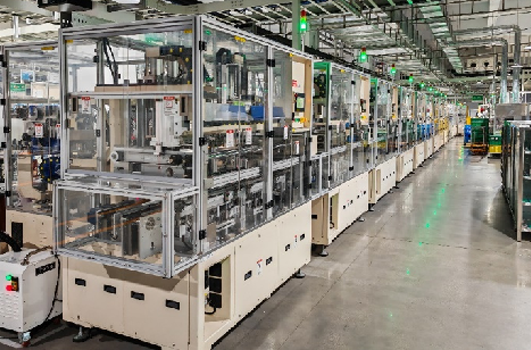
The production line follows a linear flow layout with assembly stations arranged sequentially. Buffer zones between stations accommodate minor upstream interruptions without stopping the entire line. Each station is accessible for maintenance with dedicated service walkways. This type of layout minimizes floor space and maximizes material flow, ensuring efficient line-side parts delivery.
The system supports flexible manufacturing—a core concept of Industry 4.0 that involves using advanced automation and robotics technologies to build efficient and adaptable manufacturing tasks. The line is designed to accommodate multiple motor variants, enabling manufacturers to respond quickly to changing product requirements without extensive retooling.
Results & ROI
- Metric Before (Manual) After (Automated) Improvement
- Production Throughput Baseline +200–300% 2–3x increase
- Labor Requirements Full manual team Reduced 60–70% Significant cost savings
- Product Consistency Variable Highly consistent Reduced variation
- Defect Rate 3–5% < 1% 4–5x improvement
- Production Monitoring Manual logs Real-time digital Instant visibility
- Traceability Limited Full end-to-end Complete batch tracking
- Key ROI Drivers:
- Reduced Labor Costs – Automation replaces repetitive manual tasks
- reducing headcount requirements by 60–70%. Industry data shows automation can deliver 45% labor savings in automotive manufacturing.
- Improved Quality – Vision inspection and automated testing catch defects early
- reducing rework and scrap. Advanced machine vision systems can detect deviations as small as 0.1mm
- far surpassing manual inspection capability.
- Higher Throughput – Automated systems run continuously with consistent speed and accuracy
- delivering 200–300% throughput improvement over manual operations.
- Real-Time Monitoring – Production data visibility enables proactive decision-making and continuous improvement. Connected
- data-driven Industry 4.0 operations have been proven to improve efficiency
- quality
- and reliability while reducing unplanned downtime.
- Lower Defect Rates – Precision automation minimizes human error and improves product consistency. High-precision
- highly consistent
- and stable assembly processes significantly improve production efficiency and product reliability.
- Automation projects of this scale typically achieve first-year ROI exceeding 170%.
Equipment List
- Equipment Function Key Specification
- Automatic Component Feeders Supply components to assembly stations Vibratory bowl / conveyor type with consistent timing
- Precision Assembly Stations Automated pick-and-place and fastening Servo-driven
- torque-controlled
- with twin electric presses
- Thermal Paste Dispensing Robot Apply thermal paste to components Robotic dispensing with precise volume control
- Press-Fitting Stations Bearing and component press-fit Precision force and position control
- In-Line Test Stations Electrical and mechanical testing Automated pass/fail logging
- end-of-line testing
- Vision Inspection Systems Dimensional and surface quality inspection High-resolution cameras
- AI-assisted detection
- Traceability System Product identification and tracking Unique coding
- database integration
- Automated Packaging Line Cartoning
- labeling
- palletizing Integrated end-of-line solution
- Data Collection System Real-time production monitoring Sensor network
- PLC integration
- MES Connection Central production control ERP/MES integration for Industry 4.0
Project Overview / Opening
The Fully Automated Motor Assembly Line represents a complete transformation of traditional motor manufacturing—replacing manual, labor-intensive assembly with a smart, integrated production system designed for the demands of modern manufacturing.
In today's competitive manufacturing environment, motor and electronic product manufacturers face pressure to increase output, improve quality, and reduce costs simultaneously. This project demonstrates how a fully integrated automation solution addresses these challenges through a combination of precision assembly, automated testing, vision inspection, and smart factory connectivity.
The system is designed for electric motor, electronic product, and automotive component manufacturing—industries that require high precision, consistent quality, and reliable traceability. Assembly lines have evolved significantly since the first Model T left Ford's factory, and the most impactful change is the increase in automation, with machines handling many of the most critical or dangerous parts of assembly.
This case study examines the complete project lifecycle—from initial challenges and solution design through implementation and measurable results—providing actionable insights for manufacturers considering similar automation investments.
Key Points
- ✅ Fully Integrated System – Combines assembly, testing, inspection, and packaging into one seamless production line, eliminating manual handoffs and coordination gaps
- ✅ 200% Throughput Increase – Automated systems operate continuously at consistent high speed, delivering 2–3x the output of manual lines
- ✅ Reduced Labor Dependency – Replaces 60–70% of repetitive manual tasks with reliable automated processes
- ✅ Improved Product Quality – Vision inspection and precision assembly ensure consistent product quality with defects reduced from 3–5% to under 1%
- ✅ Sub-Millimeter Precision – Vision systems detect surface scratches and assembly deviations as small as 0.1mm
- ✅ Real-Time Production Monitoring – Intelligent data collection provides complete visibility into OEE and process performance
- ✅ End-to-End Traceability – Every product is tracked from component feeding through final packaging with unique identification codes
- ✅ Industry 4.0 Ready – MES connectivity and smart system integration enable data-driven manufacturing
- ✅ Flexible Manufacturing – Line accommodates multiple motor variants without extensive retooling
Implementation / Workflow
Phase 1: Requirement DefinitionDefine production capacity targets and quality standards
Identify motor variants and assembly specifications
Establish traceability and data collection requirements
Conduct feasibility study and ROI analysis
Phase 2: System DesignDesign the production line layout and workflow sequence
Specify automation equipment and control systems
Define interfaces between assembly, testing, and packaging modules
Plan for flexible manufacturing capability across multiple motor variants
Phase 3: Equipment IntegrationProcure and integrate all automation modules
Configure PLC, HMI, and MES connectivity
Develop and test production control software
Integrate vision inspection systems at multiple inspection points
Phase 4: Commissioning and TestingInstall and commission the full production line
Conduct dry runs and production trials
Fine-tune parameters for optimal performance
Validate vision system accuracy and test station reliability
Phase 5: Production Ramp-UpTrain operators and maintenance personnel
Monitor initial production for quality and throughput
Optimize processes based on real production data
Establish baseline performance metrics
Phase 6: Handover and SupportTransfer operational documentation and procedures
Provide ongoing technical support and maintenance guidance
Conduct knowledge transfer for internal team self-sufficiency
Customer Value / Results
Operational BenefitsHigher Production Throughput – Automated systems operate at consistent high speed, delivering 200–300% of the output of manual lines. High-precision, highly consistent, and stable assembly processes significantly improve production efficiency.
Improved Product Consistency – Precision automation reduces variation in final products. Advanced machine vision technology dramatically enhances quality control capabilities, detecting defects that human inspectors would miss.
Lower Operating Costs – Reduced labor requirements (60–70%) and lower defect rates (from 3–5% to under 1%) translate directly to lower per-unit costs.
Real-Time Visibility – Production data enables informed decision-making and continuous improvement. Connected, data-driven operations improve efficiency, quality, and reliability while reducing unplanned downtime.
End-to-End Traceability – Complete tracking from component to finished product supports quality records, batch tracking, and regulatory compliance.
Strategic BenefitsCompetitive Advantage – Automation enables faster response to customer demand and higher production capacity. Manufacturers can scale output without proportional increases in labor costs.
Scalability – The system can be adapted for different motor variants and production volumes. Flexible manufacturing capabilities allow quick changeovers between product types.
Long-Term Reliability – Designed for continuous operation with minimal downtime. Automated systems handle critical and repetitive tasks with consistent quality.
Smart Factory Foundation – Integration with MES and data systems supports digital transformation. Intelligent systems incorporating robotics, image recognition, and data analysis represent the future of motor production.
Conclusion / Next Step
The Fully Automated Motor Assembly Line demonstrates how smart manufacturing technologies can transform traditional motor and electronic product assembly into a highly efficient, quality-driven production system. By integrating automated assembly, vision inspection, testing, and packaging into one seamless line, manufacturers can achieve higher throughput, improved product consistency, and lower operating costs.
What This Means for Your Factory:
If you are currently relying on manual assembly or operating with disconnected production equipment, this case study shows the potential of a fully integrated automation solution. The same approach can be applied to electric motors, electronic products, consumer electronics, automotive components, and industrial equipment manufacturing.
Key Takeaways:
Automation can deliver 200%+ throughput improvement
Defect rates can be reduced by 80% or more
Labor requirements can be cut by 60–70%
Industry 4.0 integration provides real-time visibility and data-driven decision-making
Next Steps:
Evaluate Your Current Production – Identify bottlenecks, quality issues, and labor-intensive processes in your motor or electronics assembly operations
Define Your Automation Goals – Set clear targets for throughput, quality, and cost reduction
Request a Project Assessment – Contact 13ASRS for a preliminary evaluation of your automation project
Contact Information:
Website: https://13asrs.com/
YouTube: @13machine – Smart factory projects, automated production lines, and industrial automation case studies
If you are planning a factory automation upgrade, 13ASRS can help you evaluate the project, design the solution, and estimate the investment required.
Related Blog
Start with Your Business Challenge
Tell us about your warehouse, factory, or production requirements. We'll help you explore practical automation solutions and relevant project references.