Industry 4.0 in Motor Manufacturing: How Smart Assembly Lines Are Shaping the Future of Production
Summary
The motor manufacturing industry is undergoing a fundamental transformation driven by Industry 4.0 technologies. From digital twins and AI-powered vision inspection to predictive maintenance and fully traceable production systems, smart assembly lines are redefining what is possible in electric motor production. This article explores the key technologies reshaping motor manufacturing, examines real-world implementation case studies, and provides insights for manufacturers planning their Industry 4.0 journey. With the automatic motor assembly line market valued at USD 5.22 billion in 2025 and projected to reach USD 7.56 billion by 2032, the shift toward smart manufacturing is not optional—it is essential for competitiveness.
Technology
- Industry 4.0 in motor manufacturing integrates multiple advanced technologies into cohesive
- data-driven production systems. Digital twins create real-time virtual representations of physical assembly lines
- enabling offline simulation
- process optimization
- and predictive analytics before physical implementation. AI-powered vision inspection systems replace subjective manual checks with data-driven standards that detect defects as small as 0.1mm—far beyond human capability. Edge AI and IoT sensors continuously monitor vibration patterns
- temperature fluctuations
- and energy draw in motors
- conveyors
- and actuators
- enabling predictive maintenance that reduces unplanned downtime.
- Modern assembly lines integrate precision winding
- in-line metrology
- vision-guided handling
- laser processing
- and closed-loop testing. Manufacturing execution systems coordinate workflow across stations
- capturing real-time production data for complete traceability. The technology enables what industry analysts describe as connected
- data-driven operations that improve efficiency
- quality
- and reliability while reducing unplanned downtime.
Challenge
Motor manufacturers face mounting pressure to increase production capacity while maintaining consistent quality and reducing costs. Traditional assembly methods are proving inadequate for several critical reasons.
Product complexity is rising rapidly. Higher-efficiency motor designs, tighter acoustic requirements, and greater thermal management needs have increased the number of critical quality characteristics that must be controlled during assembly. In automotive applications, electric vehicle motors require precision that manual processes cannot consistently achieve.
Labor availability and cost present another significant challenge. Skilled assembly technicians are increasingly difficult to find and retain, while labor costs continue to rise. The transition to electric vehicles has intensified these pressures, as EV production requires new assembly processes for battery packs, electric motors, and power electronics.
Quality consistency remains a persistent issue. Human error in winding, component alignment, and fastening leads to variability that directly affects product performance. Without comprehensive traceability, manufacturers struggle to identify root causes of defects or respond effectively to quality issues. These challenges are compounded by shorter product cycles and volatile supply conditions that demand greater manufacturing flexibility.
Solution
Industry 4.0 technologies address these challenges by transforming traditional assembly lines into intelligent, data-driven production systems. The solution combines multiple advanced technologies into integrated platforms capable of handling the full production spectrum—from component feeding through final testing and packaging.
Digital Twins create virtual replicas of physical production lines, enabling offline simulation and optimization of manufacturing processes before physical implementation. Siemens, for example, used a digital twin to plan and optimize a fully automated warehouse at its electric motor plant, increasing productivity by 40 percent.
AI-Powered Vision Inspection replaces subjective manual checks with data-driven standards that identify flaws invisible to the naked eye. Systems can detect surface scratches, dents, and contamination as fine as 0.1mm while maintaining cycle times under five seconds.
Predictive Maintenance uses edge AI and IoT sensors to continuously monitor equipment health, detecting anomalies before they cause failures. This moves maintenance from a reactive activity to a condition-based strategy that reduces unplanned downtime.
Full Traceability systems record process parameters and material batch information throughout production, enabling complete quality tracking and rapid root cause analysis.
Workflow & Layout
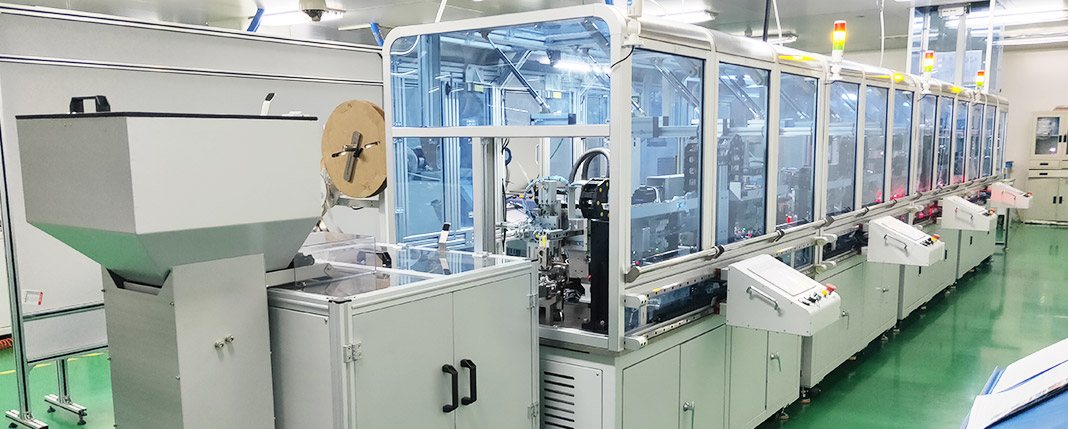
Industry 4.0 motor assembly lines follow a structured workflow designed to maximize throughput while maintaining quality. The production sequence begins with component feeding, where automated systems deliver parts to assembly stations with consistent timing and orientation.
Stator assembly stations perform precision placement of stators into motor housings. Rotor assembly follows, with automated insertion and bearing press-fit operations. Final motor assembly includes end cap attachment and shaft alignment, followed by inline testing for electrical, insulation resistance, and mechanical performance.
Modern lines feature modular design supporting rapid switching between multiple motor models. In one case study, a complete EPS motor assembly line achieved changeover times under 20 minutes while maintaining a yield rate of 98% and utilization rate of 90%. The line employs a hybrid system of conveyor lines and robotic handling with approximately 18 machines.
The integrated control system allows one-click switching between production models while enabling full-line data collection and traceability. Error-proof and fail-safe designs—including program interlocks, profile-matching jigs, guiding mechanisms, and sensor monitoring—ensure production safety and correct operation of each process step.
Results & ROI
- Industry 4.0 implementation delivers measurable improvements across multiple dimensions. The automatic motor assembly line market reflects this value
- valued at USD 5.22 billion in 2025 and projected to reach USD 7.56 billion by 2032.
- Real-world results demonstrate the impact. A complete EPS motor assembly line achieved a line cycle time of 29 seconds per unit
- changeover time under 20 minutes
- yield rate of 98%
- and utilization rate of 90%—with only one operator for unloading and packaging plus three to four for offline material feeding.
- SEG Automotive entered series production for 800V e-machine components in just 15 months from first customer exchange to production start
- featuring smart Industry 4.0 solutions including full traceability
- digital twins
- and automated guided vehicle transport.
- Siemens invested four million euros in a fully automated warehouse at its electric motor plant
- using digital twin technology to optimize processes before construction. The result: 40% productivity increase
- 99% reduction in order picking errors
- and 40% reduction in material circulation.
- AI-powered vision inspection systems achieve 0.1mm defect sensitivity with false rejection rates under 0.5% and zero false acceptance rates
- replacing subjective manual inspections with data-driven quality standards.
Equipment List
- The equipment configuration for Industry 4.0 motor assembly lines varies by application
- but typically includes the following core components.
- Assembly Equipment includes servo presses with closed-loop force-displacement control
- transducerized tightening systems with traceable data
- automated screw feeding systems
- precision dispensing systems for adhesives and coatings
- and robotic pick-and-place units.
- Inspection and Testing equipment features AI-powered vision inspection systems with sub-millimeter defect detection
- automated optical inspection platforms
- in-circuit testing stations
- and end-of-line functional testers.
- Material Handling systems include conveyor systems for product transport
- vibratory bowl feeders for component supply
- and pallet-based transfer systems enabling flexible product routing.
- Software and Control includes PLC and HMI systems for machine-level control
- MES software for production coordination
- SCADA systems for real-time monitoring
- and digital twin platforms for simulation and optimization. Full-process data traceability systems record process parameters and material batch information throughout production.
Project Overview / Opening
The transformation of motor manufacturing through Industry 4.0 represents one of the most significant shifts in modern industrial production. What was once a niche approach has become a strategic manufacturing backbone across industries that depend on compact, efficient, and increasingly specialized electric motors.
The numbers tell the story. The automatic motor assembly line market was valued at USD 5.22 billion in 2025 and is projected to reach USD 7.56 billion by 2032. The intelligent manufacturing line market for new energy vehicle electric drive systems was valued at USD 5.53 billion in 2025 and is projected to grow to USD 8.65 billion by 2032.
This growth reflects a fundamental shift in manufacturing strategy. Whether the end use is mobility, industrial drives, home appliances, medical devices, or robotics, producers face the same central mandate: deliver consistent performance at scale while navigating tighter tolerances, shorter product cycles, and volatile supply conditions.
Assembly automation is no longer limited to simple screwdriving and press-fit stations. It now integrates precision winding, in-line metrology, vision-guided handling, laser processing, and closed-loop testing to ensure every motor meets demanding functional and safety expectations.
Key Points
- Market Growth: Automatic motor assembly line market projected to grow from USD 5.22 billion (2025) to USD 7.56 billion (2032)
- Digital Twins: Create virtual replicas of production lines for offline simulation, process optimization, and predictive analytics
- AI Vision Inspection: Detects defects as small as 0.1mm with zero false acceptance rates
- Predictive Maintenance: Edge AI and IoT sensors reduce unplanned downtime by detecting anomalies before they cause failures
- Full Traceability: Complete quality tracking from component feeding through final packaging
- Modular Design: Supports rapid switching between multiple motor models with changeover times under 20 minutes
- Proven Results: 40% productivity increase, 98% yield rate, and 90% utilization rate achieved in real-world deployments
- Industry 4.0 Integration: Connected, data-driven operations improve efficiency, quality, and reliability
Implementation / Workflow
Successful Industry 4.0 implementation in motor manufacturing follows a structured process designed to maximize ROI and minimize risk.
Phase 1: Assessment and Planning. Evaluate current production processes, identify bottlenecks and quality issues, and define clear automation goals. Establish baseline metrics for throughput, quality, and cost.
Phase 2: Technology Selection. Select Industry 4.0 technologies that align with production requirements. Key technologies include digital twins for simulation, AI vision for inspection, IoT sensors for monitoring, and MES for production coordination.
Phase 3: System Integration. Integrate automation equipment with PLC, HMI, and MES connectivity. Configure production control software and establish full-process data traceability.
Phase 4: Commissioning and Validation. Install and commission the full production line. Conduct dry runs and production trials to validate system performance. Fine-tune parameters for optimal operation.
Phase 5: Production Ramp-Up. Train operators and maintenance personnel. Monitor initial production for quality and throughput. Optimize processes based on real production data.
Phase 6: Continuous Improvement. Establish ongoing processes for performance monitoring, data collection and analysis, and identification of optimization opportunities.
Customer Value / Results
The value delivered by Industry 4.0 in motor manufacturing extends across operational, financial, and strategic dimensions.
Operational Value. Automation transforms assembly from a labor-intensive constraint into a seamless production process. Throughput increases are substantial, with complete lines achieving cycle times under 30 seconds per unit. Model changeover time can be reduced to under 20 minutes. Production monitoring becomes real-time and data-driven, enabling proactive decision-making.
Financial Value. Labor requirements are significantly reduced—a complete EPS motor assembly line requires only one operator for unloading plus three to four for offline material feeding. Quality-related costs fall as defect rates decline. Yield rates of 98% and utilization rates of 90% are achievable. Productivity increases of 40% have been documented.
Strategic Value. Modular design supports replication across other production lines or overseas factories. Full traceability enables effective quality management and rapid root cause analysis. Industry 4.0 capabilities are increasingly important for securing contracts with major OEMs.
Quality Value. AI-powered vision inspection achieves 0.1mm defect sensitivity with false rejection rates under 0.5%, replacing subjective manual inspections with data-driven standards. This ensures consistent quality that meets the demanding requirements of modern motor applications.
Conclusion / Next Step
Industry 4.0 is fundamentally reshaping motor manufacturing. Digital twins, AI-powered vision inspection, predictive maintenance, and fully traceable production systems are transforming traditional assembly lines into intelligent, data-driven production platforms. The results are clear: higher throughput, improved quality, lower costs, and greater flexibility.
The automatic motor assembly line market, valued at USD 5.22 billion in 2025, is projected to reach USD 7.56 billion by 2032. This growth reflects a fundamental recognition among manufacturers that Industry 4.0 is not optional—it is essential for competitiveness.
For manufacturers evaluating Industry 4.0 investments, the path forward is clear. Start by assessing your current production processes to identify bottlenecks, quality issues, and opportunities for automation. Define clear goals for throughput, quality, and cost reduction. Engage with experienced automation partners who understand both the technical requirements and the industry-specific challenges of motor manufacturing.
If you are planning a factory automation upgrade for motor assembly, automotive electronics production, or related manufacturing applications, 13ASRS can help evaluate your project, design the solution, and estimate the investment required. Visit https://13asrs.com/ or subscribe to @13machine on YouTube for smart factory projects, automated production lines, and industrial automation case studies.
Related Blog
Start with Your Business Challenge
Tell us about your warehouse, factory, or production requirements. We'll help you explore practical automation solutions and relevant project references.