Stacker Crane vs Forklift: Which Is Safer for Chemical Drum Handling?
Summary
Chemical drum handling is one of the highest-risk operations in industrial warehousing due to heavy loads, hazardous materials, and human-machine interaction risks.
The traditional forklift-based system is widely used but introduces significant safety challenges.
In contrast, stacker crane ASRS systems provide fully automated, controlled, and stable handling environments, significantly reducing accident risk and improving compliance with chemical industry safety standards.
This article compares forklift operations with stacker crane automation in terms of safety, load stability, compliance, and labor risk reduction.
Technology
- This comparison involves two core systems:
- Forklift-Based Manual System:
- Human-operated forklifts
- Manual pallet handling
- On-floor navigation
- Operator-dependent safety control
- Stacker Crane ASRS System:
- Automated stacker crane handling
- WMS/WCS controlled movement
- Fixed rail-based navigation
- Sensor-driven load stability control
- SCADA monitoring system
Challenge
Chemical drum warehouses face extremely high operational risk because:
Drums contain hazardous or flammable materials
Loads are heavy and unstable
Human error can lead to serious accidents
Forklift operations require constant manual control
Visibility and maneuverability limitations exist
Even small operational mistakes can result in:
Chemical leakage
Fire or explosion risk
Worker injury
Regulatory violations
Production downtime
Solution
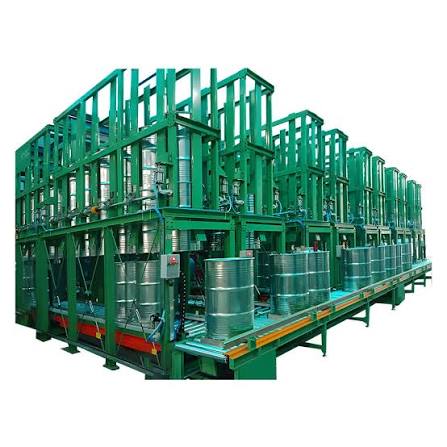
Stacker crane ASRS systems eliminate manual handling in hazardous environments by fully automating:
Heavy load lifting
Vertical storage
Horizontal transport (via integrated systems)
Storage decision logic (via WMS/WCS)
This creates a closed, controlled, and predictable warehouse environment with minimal human exposure.
Workflow & Layout
Forklift-Based Workflow:
Human operator picks up chemical drum pallet
Forklift transports load through warehouse aisles
Manual placement into storage racks
Repeated inbound/outbound movement cycles
⚠️ Risk points: turning, lifting instability, human fatigue, collision hazards
Stacker Crane ASRS Workflow:
WMS assigns storage location
Conveyor transfers drum to ASRS input station
Stacker crane lifts and transports load automatically
System places load into predefined rack location
Automated retrieval when needed
✔ Fully controlled system movement
✔ No human exposure in storage zone
Results & ROI
- Safety Improvements:
- Significant reduction in forklift-related accidents
- Elimination of manual handling in hazardous zones
- Reduced chemical exposure risk
- Operational Efficiency:
- Continuous 24/7 automated operation
- Higher consistency in load handling
- Reduced downtime due to human error
- Efficiency Gains:
- 200–400% improvement in handling efficiency
- Stable and predictable throughput
- Reduced operational variability
- ROI Impact:
- Safety-related cost reduction contributes significantly to:
- 👉 lower insurance costs
- 👉 fewer accident-related losses
- 👉 improved regulatory compliance efficiency
Equipment List
- Forklift System Components:
- Industrial forklifts
- Manual racking systems
- Operator control systems
- Safety monitoring cameras
- Stacker Crane ASRS Components:
- Automated stacker crane system
- Reinforced chemical drum racks
- Conveyor transfer system
- WMS/WCS control system
- SCADA monitoring platform
- Safety sensors and interlocks
Project Overview / Opening
Forklift operations have been the standard in chemical warehouses for decades, but they are increasingly unsuitable for modern safety and efficiency requirements.
As chemical logistics becomes more regulated and high-risk, automation systems such as stacker crane ASRS are replacing manual handling to ensure safer and more controlled operations.
Key Points
- 1️⃣ Forklift Accident Risk vs ASRS Safety
- Forklift risks include:
- Operator error
- Collision with racks or drums
- Load tipping accidents
- Visibility limitations
- ASRS advantages:
- No human operation in storage zones
- Controlled robotic movement
- Sensor-based safety systems
- 2️⃣ Manual Handling vs Automation Comparison
- Manual systems depend on:
- Human skill
- Fatigue levels
- Training consistency
- Automation provides:
- Standardized execution
- Continuous operation
- Predictable performance
- 3️⃣ Load Stability Analysis
- Forklifts:
- Load stability depends on operator skill
- High risk during lifting and turning
- Stacker cranes:
- Fixed rail-guided movement
- Continuous load monitoring
- Stable vertical lifting system
- 4️⃣ Chemical Industry Safety Compliance
- Stacker crane ASRS systems support:
- Hazardous material zoning compliance
- Explosion-proof system integration
- Controlled access environments
- Automated safety shutdown systems
- Forklifts often require additional procedural controls to meet the same standards.
- 5️⃣ Labor Risk Reduction
- Automation reduces:
- Physical workload
- Exposure to hazardous chemicals
- Dependence on trained forklift operators
- Workplace injury rates
Implementation / Workflow
Phase 1: Safety Risk Assessment (2–3 weeks)
Forklift risk evaluation
Chemical hazard classification
Phase 2: System Design (2–4 weeks)
ASRS layout planning
Load flow optimization
Phase 3: Engineering Integration (4–8 weeks)
Crane system installation
Software integration (WMS/WCS/SCADA)
Phase 4: Installation (2–4 weeks)
Equipment deployment
System calibration
Phase 5: Commissioning (1–2 weeks)
Safety validation
Operational testing
Customer Value / Results
Operational Value:
Safer chemical handling environment
Stable automated operations
Reduced human dependency
Safety Value:
Lower accident probability
Improved compliance with industrial regulations
Controlled hazardous material flow
Financial Value:
Lower long-term accident-related costs
Reduced insurance and liability risks
Improved operational efficiency
Conclusion / Next Step
In chemical drum handling environments, safety is not optional—it is a core operational requirement.
Compared to forklifts, stacker crane ASRS systems provide:
✓ Fully automated handling
✓ Higher load stability
✓ Zero human exposure in hazardous zones
✓ Strong regulatory compliance support
✓ Significant reduction in accident risk
For modern chemical warehouses, automation is not just an efficiency upgrade—it is a fundamental safety transformation.
If you are evaluating forklift replacement or chemical warehouse automation, we can help design a safe, compliant, and high-efficiency ASRS system tailored to your operational requirements.
Related Blog
Start with Your Business Challenge
Tell us about your warehouse, factory, or production requirements. We'll help you explore practical automation solutions and relevant project references.