5 Major Warehouse Problems That ASRS Automation Solves in Large Logistics Centers
Summary
Large logistics centers face increasing operational pressure due to rising order volumes, SKU complexity, and labor instability.
Traditional warehouse systems struggle to maintain efficiency, accuracy, and scalability under these conditions.
This article explains the five most critical warehouse problems and how modern ASRS automation systems (including ACR + AMR architectures) solve each of them at a system level.
Technology
- ASRS warehouse solutions typically integrate:
- ACR (Autonomous Case/Rack Robots)
- AMR (Autonomous Mobile Robots)
- WMS (Warehouse Management System)
- WCS (Warehouse Control System)
- 3D SCADA visualization system
- High-density racking systems
- Dynamic task scheduling engine
- Real-time inventory tracking system
- Conveyor buffer systems
- Automated charging infrastructure
Challenge
Modern logistics centers face structural inefficiencies that cannot be solved by simply adding more labor or expanding warehouse space.
Key challenges include:
Rising labor costs and shortage of skilled workers
Increasing order complexity and SKU diversity
Limited warehouse space utilization efficiency
Slow and inconsistent order processing
Difficulty scaling operations during peak demand
These problems directly impact delivery speed, cost efficiency, and customer satisfaction.
Solution
ASRS automation systems solve these challenges by transforming warehouse operations into a fully coordinated robotic ecosystem.
Key principles:
Replace manual movement with robotic transport
Centralize decision-making via WMS/WCS
Enable real-time task scheduling
Separate storage, transport, and picking functions
Build scalable multi-zone architecture
This creates a stable, high-efficiency logistics system.
Workflow & Layout
Typical ASRS workflow in a large logistics center:
Step 1: Inbound Receiving
Goods are scanned, registered, and assigned digital identities in WMS.
Step 2: Automated Storage (ACR System)
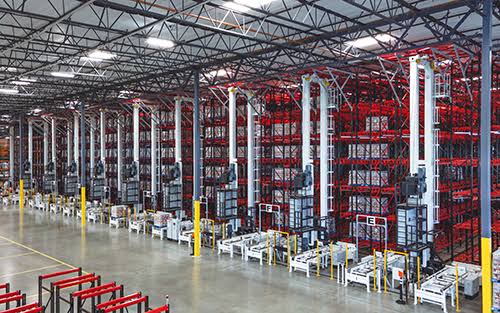
ACR robots store goods into high-density racks based on:
SKU frequency
Order demand
Storage optimization logic
Step 3: Intelligent Task Scheduling
WMS dynamically assigns tasks based on:
Order priority
Warehouse congestion
Robot availability
Step 4: Retrieval & Transport (ACR + AMR)
ACR retrieves bins from storage racks
AMR transports goods between zones
Step 5: Picking & Sorting
Products are consolidated and prepared for outbound shipment.
Step 6: Outbound Dispatch
Orders are automatically packaged, labeled, and shipped.
Results & ROI
- Operational Improvements:
- Throughput increase: 200–400%
- Order accuracy: up to 99.9%
- Labor dependency reduction: 50–70%
- Warehouse utilization efficiency: significantly improved
- System Performance:
- Continuous 24/7 operation capability
- Stable high-volume processing
- Reduced bottlenecks in peak seasons
Equipment List
- Core Hardware:
- ACR robotic storage system
- AMR transport robot fleet
- High-density racking system
- Conveyor buffer and sorting modules
- Automated charging stations
- Software Systems:
- WMS (Warehouse Management System)
- WCS (Warehouse Control System)
- SCADA 3D visualization system
- Fleet scheduling engine
- Real-time inventory tracking system
- Optional Enhancements:
- AI-based demand forecasting system
- Vision inspection modules
- ERP integration
- Multi-warehouse coordination platform
Project Overview / Opening
Warehouse inefficiencies are no longer operational issues—they are structural limitations of traditional logistics design.
ASRS automation replaces fragmented manual workflows with a fully integrated robotic system that ensures consistency, speed, and scalability.
This enables logistics centers to operate as intelligent, self-optimizing systems.
Key Points
- 1️⃣ Labor Shortage
- Problem:
- Warehouses rely heavily on manual labor, which is unstable and increasingly expensive.
- ASRS Solution:
- Robots replace manual transport and picking
- 24/7 automated operation
- Reduced dependency on workforce availability
- 2️⃣ Picking Errors
- Problem:
- Manual picking leads to mis-picks, returns, and customer dissatisfaction.
- ASRS Solution:
- System-controlled picking via WMS/WCS
- Barcode and SKU validation
- Automated bin tracking
- 3️⃣ Low Space Utilization
- Problem:
- Traditional warehouses waste vertical and horizontal space.
- ASRS Solution:
- High-density racking systems
- ACR deep storage optimization
- Dynamic slot allocation
- 4️⃣ Slow Order Processing
- Problem:
- Manual workflows create delays between storage and fulfillment.
- ASRS Solution:
- Parallel robot operations
- Real-time task scheduling
- AMR fast transport layer
- 5️⃣ Scalability Issues
- Problem:
- Traditional systems cannot scale without major redesign.
- ASRS Solution:
- Modular robot expansion
- Scalable rack systems
- Software-driven capacity increase
Implementation / Workflow
Phase 1: Warehouse Assessment (2–3 weeks)
Operational bottleneck analysis
SKU and order structure evaluation
Phase 2: System Design (2–4 weeks)
Layout optimization
Robot deployment planning
Phase 3: Engineering Integration (4–8 weeks)
Hardware system construction
Software integration (WMS/WCS/SCADA)
Phase 4: Installation (2–4 weeks)
On-site deployment
System configuration
Phase 5: Commissioning (1–2 weeks)
Testing and optimization
Full system launch
Customer Value / Results
Operational Value:
Eliminates key warehouse bottlenecks
Increases throughput stability
Improves order accuracy
Enables 24/7 operation
Strategic Value:
Future-proof warehouse infrastructure
Scalable logistics system
Reduced operational risk
Financial Value:
Lower cost per order
Reduced labor expenses
Improved ROI (18–36 months typical)
Conclusion / Next Step
Large logistics centers face five fundamental operational problems that directly limit growth and efficiency.
ASRS automation provides a system-level solution by integrating robotics, software intelligence, and multi-zone warehouse design.
Key success factors include:
✓ Labor automation strategy
✓ Error-free picking systems
✓ High-density storage design
✓ Fast multi-zone processing
✓ Scalable architecture planning
If you are evaluating warehouse automation for a logistics center, we can help analyze your current bottlenecks and design a tailored ASRS solution based on your operational requirements.
Related Blog
Start with Your Business Challenge
Tell us about your warehouse, factory, or production requirements. We'll help you explore practical automation solutions and relevant project references.