How Much Does a 33 ACR + 18 AMR Automated Warehouse Cost in 2026?
Summary
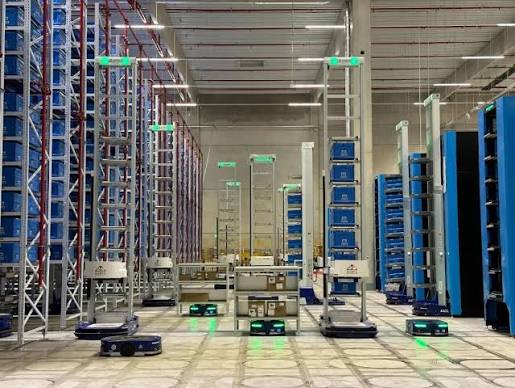
A fully automated warehouse system combining 33 ACR robots and 18 AMR robots represents a mid-to-large scale ASRS investment designed for high SKU, high throughput logistics operations.
In 2026, the total investment for such a system can range from USD 500,000 to over USD 5,000,000, depending on storage capacity, warehouse size, automation depth, software integration, and regional installation requirements.
This article breaks down the real cost structure, ROI expectations, and hidden expenses behind modern ASRS warehouse automation systems.
Technology
- A complete ASRS warehouse system typically integrates the following technologies:
- 33 ACR (Autonomous Case/Rack Robots)
- 18 AMR (Autonomous Mobile Robots)
- High-density racking system (single/double deep)
- WMS (Warehouse Management System)
- WCS (Warehouse Control System)
- 3D SCADA visualization platform
- Dynamic task scheduling algorithms
- Automatic charging stations
- Conveyor buffer systems
- Real-time inventory tracking system
Challenge
Most companies planning warehouse automation struggle with cost uncertainty.
Common challenges include:
Lack of transparent pricing models
Hidden integration costs
Misunderstanding of robot vs system cost
Overestimating ROI speed
Underestimating software complexity
Difficulty comparing vendors fairly
Without a clear cost breakdown, many projects either overbudget or under-design their systems.
Solution
A proper ASRS investment should be evaluated as a system-level project, not individual equipment purchase.
Cost should be analyzed across:
Hardware (robots + racking)
Software (WMS/WCS/SCADA)
Integration (system engineering)
Installation (on-site commissioning)
Operation (labor + maintenance savings)
This approach ensures realistic budgeting and ROI forecasting.
Workflow & Layout
A typical 33 ACR + 18 AMR warehouse operates through:
Step 1: Inbound Receiving
Goods are scanned, labeled, and assigned system identity.
Step 2: AMR Transport Layer
AMR robots move goods into designated warehouse zones.
Step 3: ACR Storage System
ACR robots store goods into high-density racks with dynamic slot allocation.
Step 4: Intelligent Storage Management
WMS optimizes storage location based on:
SKU velocity
Order frequency
Storage density
Step 5: Order Fulfillment
ACR retrieves bins while AMR transports goods to packing stations.
Step 6: Outbound Dispatch
Packed orders are automatically sent to shipping zones.
Results & ROI
- Typical Performance Improvements:
- Storage efficiency: +30% to +60%
- Labor reduction: 50% to 70%
- Order accuracy: up to 99.9%
- Throughput: 300–600 bins/hour (system dependent)
- ROI Timeline:
- Most ASRS systems achieve ROI within:
- 18–36 months
- depending on:
- labor cost level
- warehouse utilization rate
- order volume
- automation intensity
Equipment List
- Core system equipment includes:
- 33 ACR intelligent storage robots
- 18 AMR transport robots
- Multi-layer racking system
- Conveyor buffer zones
- Automatic charging stations
- Warehouse control system (WCS)
- Warehouse management system (WMS)
- SCADA visualization platform
- Safety scanning system
- High-speed sorting modules
Project Overview / Opening
The cost of warehouse automation is not defined by robots alone.
It is defined by how well the entire system integrates storage, movement, intelligence, and fulfillment into a single operational flow.
A 33 ACR + 18 AMR system is not just a warehouse upgrade—it is a complete operational transformation.
Key Points
- 1. Cost Structure Breakdown
- Typical ASRS investment distribution:
- Hardware (robots + racking): 40–60%
- Software systems: 10–20%
- Integration & engineering: 15–25%
- Installation & commissioning: 10–20%
- 2. Investment Range (2026 Market)
- Small-scale ASRS:
- USD 50,000 – 300,000
- Mid-scale automation:
- USD 300,000 – 1,500,000
- Large-scale system (like this case):
- USD 1,500,000 – 5,000,000+
- 3. Hidden Costs Often Ignored
- System integration complexity
- Warehouse layout redesign
- IT infrastructure upgrades
- Commissioning downtime
- Operator training costs
- Maintenance planning systems
- These can account for 10–25% of total project cost.
- 4. Traditional Warehouse vs Automated Warehouse
- Traditional Warehouse:
- High labor dependency
- Lower upfront cost
- High long-term operational cost
- Limited scalability
- Automated Warehouse:
- Higher initial investment
- Lower operating cost
- High scalability
- High order accuracy
Implementation / Workflow
Phase 1: System Design (2–4 weeks)
Layout planning + simulation + capacity design
Phase 2: Manufacturing (6–10 weeks)
Robot production + racking fabrication
Phase 3: Software Integration (3–6 weeks)
WMS/WCS + system logic configuration
Phase 4: Installation (2–4 weeks)
On-site assembly and system deployment
Phase 5: Commissioning (1–2 weeks)
Testing, debugging, optimization
Customer Value / Results
Operational Value:
Faster order fulfillment
Reduced warehouse labor dependency
Higher accuracy and traceability
24/7 automated operation capability
Financial Value:
Reduced long-term operating cost
Improved warehouse ROI efficiency
Better space utilization
Strategic Value:
Scalable logistics infrastructure
Future-proof warehouse architecture
Multi-warehouse coordination capability
Conclusion / Next Step
The cost of a 33 ACR + 18 AMR automated warehouse in 2026 typically ranges from USD 1.5M to 5M+, depending on system complexity and warehouse scale.
However, the real decision is not only about cost—but about long-term operational efficiency and scalability.
Before investing, companies should evaluate:
✓ Warehouse throughput requirements
✓ SKU complexity
✓ Labor cost structure
✓ Expansion strategy
✓ ROI expectations
If you are planning a warehouse automation project, we can help design a tailored ASRS solution, simulate system performance, and provide a detailed investment breakdown.
Related Blog
Start with Your Business Challenge
Tell us about your warehouse, factory, or production requirements. We'll help you explore practical automation solutions and relevant project references.