Chemical Drum Warehouse Automation: Full Workflow Explained Step by Step
Summary
Chemical drum warehouse automation is a highly structured industrial process designed to safely manage hazardous materials, heavy loads, and strict compliance requirements.
This article provides a complete step-by-step breakdown of the end-to-end automated workflow, from inbound receiving to outbound dispatch, using a stacker crane ASRS system integrated with WMS, WCS, and SCADA platforms.
It is designed for engineers, project planners, and decision-makers who need a clear understanding of how modern chemical automation systems operate in real industrial environments.
Technology
- A complete chemical drum ASRS workflow relies on:
- Heavy-duty stacker crane ASRS system
- Reinforced chemical drum pallet racking system
- WMS (Warehouse Management System)
- WCS (Warehouse Control System)
- SCADA real-time monitoring platform
- Industrial conveyor transfer systems
- Safety interlock and emergency control systems
- Load stability and weight detection sensors
- Explosion-proof electrical infrastructure
- Hazardous material zoning system
Challenge
Chemical drum warehouses require extremely precise and safe handling due to:
Heavy and unstable drum loads
Hazardous chemical properties
Strict regulatory compliance requirements
High risk of manual handling errors
Complex material flow coordination
Without automation, warehouse operations often suffer from:
Inefficient workflows
High labor dependency
Increased safety risks
Poor traceability
Solution
A stacker crane-based ASRS system solves these challenges by creating a fully automated, system-driven workflow where:
All movements are controlled digitally
Storage decisions are optimized by WMS
Execution is managed by WCS
System status is monitored via SCADA
This ensures:
✔ safety
✔ accuracy
✔ efficiency
✔ traceability
Workflow & Layout
Below is the complete chemical drum ASRS workflow cycle:
Step 1: Inbound Receiving
Chemical drums arrive at the warehouse and are:
Inspected for safety compliance
Scanned into WMS system
Assigned hazard classification codes
Logged into inventory database
Step 2: Pre-Storage Buffer Zone
Drums are temporarily placed in a controlled buffer area where:
Safety checks are verified
System confirms storage availability
WCS prepares execution tasks
Step 3: Stacker Crane Storage Execution
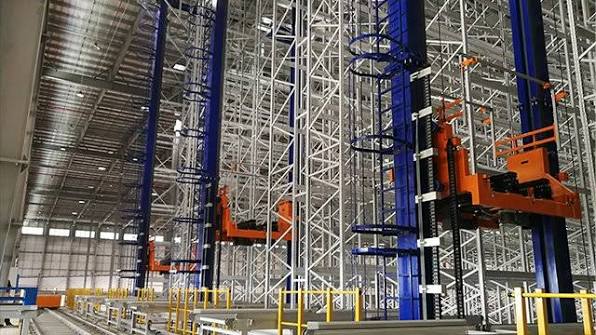
The stacker crane performs:
Automated vertical lifting of drum pallets
Precise aisle navigation
Placement into designated rack locations
This eliminates manual forklift intervention in hazardous zones.
Step 4: High-Density Storage Management
The system optimizes storage based on:
Chemical compatibility rules
Weight distribution balance
Safety zoning separation
Storage density optimization
Step 5: Retrieval Request Trigger
When an order or production request is received:
WMS generates retrieval task
WCS assigns execution priority
SCADA monitors system status
Step 6: Automated Retrieval by Stack Crane
The stacker crane:
Retrieves required pallets
Maintains load stability control
Transfers items to output conveyor system
Step 7: Outbound Transfer
Drums are moved via conveyor systems to:
Shipping docks
Production lines
Secondary processing zones
Step 8: Final Dispatch
Outbound verification is completed:
Barcode scanning
Safety confirmation
System record update in WMS
Results & ROI
- Operational Efficiency:
- Fully automated end-to-end workflow
- 24/7 continuous operation capability
- Stable and predictable throughput
- Safety Improvements:
- Elimination of manual handling in hazard zones
- Reduced forklift operation risk
- Controlled chemical movement paths
- Efficiency Gains:
- 200–400% improvement in warehouse throughput
- Faster inbound-to-outbound cycle times
- Reduced operational bottlenecks
- ROI Impact:
- Automation reduces long-term cost through:
- Lower labor dependency
- Reduced accident-related losses
- Improved operational stability
- Typical ROI period:
- 👉 18–36 months
Equipment List
- Core Hardware:
- Heavy-duty stacker crane system
- Chemical drum pallet racking system
- Conveyor transfer systems
- Buffer zone platforms
- Safety isolation structures
- Software Systems:
- WMS warehouse management system
- WCS execution control system
- SCADA real-time monitoring system
- Inventory tracking database
- Safety Systems:
- Gas detection sensors
- Emergency stop systems
- Explosion-proof electrical systems
- Load stability monitoring sensors
- Fire suppression integration
Project Overview / Opening
Chemical drum warehouse automation is not a single-machine solution—it is a fully integrated system architecture combining robotics, software intelligence, and industrial safety engineering.
The workflow is designed to ensure:
Maximum safety
Minimum human intervention
High operational efficiency
Full traceability of hazardous materials
Key Points
- 1️⃣ Inbound → Storage → Retrieval → Outbound Flow
- The entire system follows a continuous loop:
- Inbound receiving
- Automated storage
- System-driven retrieval
- Controlled outbound dispatch
- 2️⃣ Stacker Crane Workflow Logic
- The stacker crane operates on:
- Predefined rail paths
- WMS/WCS task allocation
- Load stability control systems
- 3️⃣ WMS/WCS Control Process
- WMS: decision-making and inventory logic
- WCS: execution control and robot coordination
- 4️⃣ SCADA Monitoring System
- SCADA provides:
- Real-time visualization
- System health monitoring
- Alarm and exception management
- 5️⃣ Drum Handling Automation Cycle
- The full cycle ensures:
- No manual forklift handling in hazardous zones
- Stable and repeatable operations
- Continuous optimization of material flow
Implementation / Workflow
Phase 1: System Requirement Analysis (2–3 weeks)
Chemical classification
Workflow mapping
Capacity planning
Phase 2: System Design (2–4 weeks)
Warehouse layout design
ASRS configuration planning
Safety zoning
Phase 3: Engineering Integration (4–8 weeks)
Hardware installation
Software integration (WMS/WCS/SCADA)
Safety system deployment
Phase 4: Installation (2–4 weeks)
Equipment setup
System calibration
Functional testing
Phase 5: Commissioning (1–2 weeks)
Full workflow simulation
Load testing
Final acceptance
Customer Value / Results
Operational Value:
Fully automated warehouse workflow
Stable and predictable operations
Reduced human dependency
Safety Value:
Reduced chemical handling risk
Improved operational control
Compliance with industrial safety standards
Financial Value:
Lower long-term labor cost
Reduced accident-related losses
Improved efficiency ROI
Conclusion / Next Step
Chemical drum warehouse automation is best understood as a continuous, system-driven workflow rather than isolated equipment functions.
A stacker crane ASRS system integrated with WMS, WCS, and SCADA enables:
✓ End-to-end automation
✓ High safety standards
✓ Stable throughput performance
✓ Full traceability of operations
If you are planning a chemical warehouse automation project, we can help design a complete workflow system tailored to your safety, capacity
Related Blog
Start with Your Business Challenge
Tell us about your warehouse, factory, or production requirements. We'll help you explore practical automation solutions and relevant project references.