Complete ASRS Workflow Explained Step by Step: From Production to Automated Storage
Summary
An Automated Storage and Retrieval System (ASRS) is much more than a high-rise warehouse filled with robots. It is an integrated logistics ecosystem where production equipment, AMRs, buffer systems, RGVs, stacker cranes, Warehouse Management Systems (WMS), and Warehouse Control Systems (WCS) work together to create a continuous and intelligent material flow.
Many companies understand what an ASRS warehouse is, but far fewer understand how materials actually move through the system. This lack of visibility often makes it difficult to evaluate automation projects, estimate ROI, or optimize warehouse operations.
In this guide, we break down the complete ASRS workflow step by step, following a product from the moment it leaves the production line until it is automatically stored, retrieved, and shipped. Whether you are planning a new warehouse, upgrading an existing facility, or researching warehouse automation technologies, this article provides a clear understanding of how a modern ASRS operates.
Technology
- A complete ASRS warehouse integrates several automation technologies into one coordinated system.
- Material Transportation:
- ① Autonomous Mobile Robots (AMR)
- ② Rail Guided Vehicle (RGV)
- ③ Roller Conveyor System
- ④ Automatic Transfer Stations
- Automated Storage:
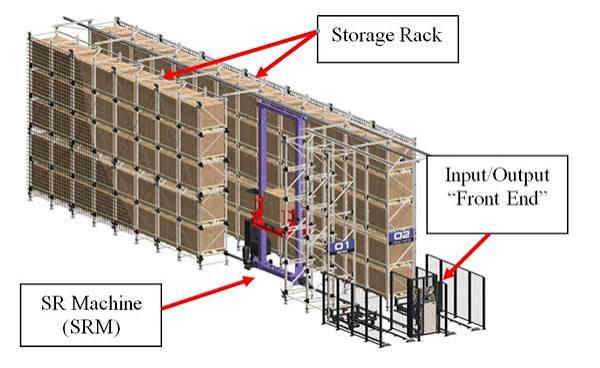
- ① High-Rise Stacker Crane
- ② High-Density ASRS Racking
- ③ Intelligent Storage Allocation
- Intelligent Software:
- ① Warehouse Management System (WMS)
- ② Warehouse Control System (WCS)
- ③ SCADA Visualization Platform
- ④ ERP/MES Integration
- Smart Technologies:
- ① Barcode & RFID Identification
- ② Real-Time Inventory Tracking
- ③ Robot Fleet Management
- ④ Automatic Charging
- ⑤ Predictive Maintenance
Challenge
Many warehouse projects focus on purchasing automation equipment without fully understanding how materials should flow through the facility.
As a result, companies often experience:
① Forklift congestion between production and storage.
② Idle robots waiting for transport tasks.
③ Bottlenecks at transfer stations.
④ Poor synchronization between production and warehouse operations.
⑤ Inventory inaccuracies caused by manual updates.
⑥ Long order fulfillment times due to inefficient workflows.
A successful ASRS project is built around material flow optimization, not simply equipment selection.
Solution
An integrated ASRS warehouse creates a seamless workflow where each technology performs a specific task.
The complete process follows this sequence:
Production
↓
AMR Transportation
↓
Buffer Zone
↓
RGV Transfer
↓
Stacker Crane Storage
↓
Automated Storage
↓
Automated Retrieval
↓
Outbound Shipping
Each stage is monitored and coordinated by the WMS and WCS, ensuring smooth, continuous, and intelligent warehouse operations.
Workflow & Layout
Step ① Production:
The workflow begins at the production line.
As finished products are completed, they are automatically identified using barcode scanners or RFID systems. Product information, including SKU, quantity, production batch, destination, and storage priority, is immediately transmitted to the Warehouse Management System.
Instead of waiting for manual warehouse personnel, the system automatically generates transportation tasks.
Purpose
• Product identification
• Data collection
• Automatic warehouse task generation
• Inventory synchronization
Step ② AMR Transportation:
Once a transportation task is issued, Autonomous Mobile Robots (AMRs) travel to the production line to collect finished products.
Unlike forklifts, AMRs navigate independently using laser SLAM or QR-code guidance, dynamically selecting the most efficient route while avoiding obstacles and other vehicles.
AMRs provide flexible transportation between production and warehouse areas without requiring fixed infrastructure.
Primary Functions
① Flexible transportation
② Automatic route planning
③ Obstacle avoidance
④ Multi-point pickup
⑤ Continuous operation
Step ③ Intelligent Buffer Zone:
The buffer zone serves as the transition point between flexible transportation and high-speed warehouse operations.
Rather than sending every product directly into storage, materials temporarily enter the buffer where the WCS organizes transportation priorities and balances warehouse traffic.
This prevents congestion during production peaks while maximizing equipment utilization.
Buffer Functions
① Temporary storage
② Flow balancing
③ Order sequencing
④ Equipment synchronization
⑤ Throughput optimization
Step ④ High-Speed RGV Transfer:
After products enter the buffer, Rail Guided Vehicles (RGVs) take over.
Unlike AMRs, RGVs operate on dedicated rails, enabling faster and more predictable transportation across fixed warehouse routes.
RGVs rapidly move products between transfer stations and stacker crane aisles while maintaining stable, uninterrupted material flow.
RGV Advantages
① High-speed transportation
② Fixed routing
③ Heavy payload capacity
④ Continuous operation
⑤ High positioning accuracy
Step ⑤ Stacker Crane Receives Goods:
At the end of the RGV route, the stacker crane automatically receives incoming pallets or containers.
The Warehouse Management System determines the optimal storage location based on inventory strategy, SKU classification, turnover frequency, and available rack capacity.
The stacker crane then lifts and positions each load with millimeter-level precision.
Storage Optimization Factors
• SKU type
• Inventory turnover
• Picking frequency
• Rack availability
• Load dimensions
Step ⑥ Automated Storage:
Once the storage location is assigned, the stacker crane deposits the product into the designated rack location.
Every storage action updates the WMS database in real time, ensuring accurate inventory visibility across the warehouse.
Because products are stored automatically, human error is virtually eliminated.
Benefits
① High storage density
② Accurate inventory records
③ Efficient space utilization
④ Automatic inventory updates
⑤ Secure storage operations
Step ⑦ Automated Retrieval:
When production requires raw materials or customer orders are released, the WMS automatically generates retrieval instructions.
The stacker crane retrieves the correct pallet or container, delivers it to the outbound transfer station, and hands it over to the RGV system.
Inventory records are updated instantly throughout the process.
Retrieval Features
① Automatic order prioritization
② FIFO / FEFO support
③ Real-time inventory tracking
④ High retrieval accuracy
⑤ Continuous operation
Step ⑧ Shipping & Dispatch:
Finally, retrieved products are transferred from the warehouse to outbound shipping.
RGVs transport products back to transfer stations, where AMRs or conveyor systems deliver them to packing lines, production areas, or shipping docks.
Every movement is monitored by the WMS, WCS, and SCADA platform, providing complete operational visibility from production to delivery.
Outbound Advantages
① Faster shipping
② Reduced manual handling
③ Improved order accuracy
④ Higher customer service levels
⑤ Complete shipment traceability
Results & ROI
- 1. Complete Workflow Comparison
- Process Manual Warehouse Integrated ASRS
- Production Transfer Forklift AMR
- Internal Transportation Manual RGV
- Storage Manual Forklift Stacker Crane
- Inventory Updates Manual Real-Time WMS
- Retrieval Manual Search Automated
- Shipping Labor Intensive Intelligent Dispatch
- 2. Material Flow Comparison
- Traditional Warehouse
- Production
- ↓
- Manual Forklift
- ↓
- Temporary Storage
- ↓
- Manual Search
- ↓
- Warehouse
- ↓
- Manual Retrieval
- ↓
- Shipping
- Frequent waiting
- duplicated handling
- and inconsistent inventory updates slow operations and increase labor dependency.
- Integrated ASRS Warehouse
- Production
- ↓
- AMR
- ↓
- Buffer
- ↓
- RGV
- ↓
- Stacker Crane
- ↓
- High-Density Storage
- ↓
- Automated Retrieval
- ↓
- Shipping
- Every step is digitally connected
- allowing continuous
- synchronized material movement with minimal manual intervention.
- 3. Operational Improvements
- An optimized ASRS workflow typically delivers:
- • Up to 300% higher warehouse throughput
- • 50–80% reduction in manual labor
- • Inventory accuracy up to 99.9%
- • 30–60% improvement in storage density
- • 2–5× faster order fulfillment
- Performance depends on warehouse size
- SKU characteristics
- and system configuration.
- 4. Material Flow Optimization
- The greatest efficiency gains come from eliminating interruptions between warehouse processes.
- Integrated scheduling ensures:
- ① Continuous transportation.
- ② Automatic task assignment.
- ③ Balanced equipment utilization.
- ④ Optimized storage allocation.
- ⑤ Reduced idle time.
- Instead of isolated operations
- the warehouse functions as one coordinated logistics system.
- 5. Return on Investment
- Higher throughput
- reduced labor costs
- improved inventory accuracy
- and optimized warehouse utilization typically enable integrated ASRS projects to achieve a payback period of 18–36 months
- making automation a strategic investment for high-volume operations.
Equipment List
- Transportation Equipment:
- ① Autonomous Mobile Robots (AMR)
- ② Rail Guided Vehicle (RGV)
- ③ Roller Conveyor System
- ④ Transfer Stations
- Storage Equipment:
- ① High-Rise Stacker Crane
- ② High-Density Storage Racks
- ③ Buffer Storage Modules
- Software Platform:
- ① Warehouse Management System (WMS)
- ② Warehouse Control System (WCS)
- ③ SCADA Visualization
- ④ ERP Integration
- ⑤ MES Integration
- Safety Systems:
- ① Laser Safety Scanners
- ② Safety PLC
- ③ Emergency Stop Devices
- ④ Fire Protection Interface
Project Overview / Opening
This ASRS workflow demonstrates how modern warehouse automation connects every stage of material handling into one intelligent process. From production output to automated transportation, high-speed transfer, precision storage, retrieval, and shipping, each subsystem contributes to a continuous and efficient logistics operation.
By integrating AMRs, RGVs, stacker cranes, WMS, and WCS, manufacturers and distribution centers can reduce manual handling, improve warehouse utilization, and support scalable, high-throughput operations that meet the demands of modern supply chains.
Key Points
- ① Material Flow Is the Foundation of Warehouse Performance
- The efficiency of an ASRS depends on how smoothly materials move between production, transportation, storage, and shipping.
- ② Each Automation Technology Has a Specialized Role
- AMRs provide flexible transportation, RGVs deliver high-speed transfers, and stacker cranes maximize storage density. Together they create a balanced and highly efficient warehouse ecosystem.
- ③ Intelligent Software Coordinates the Entire Workflow
- The WMS and WCS synchronize every movement, ensuring real-time inventory accuracy, optimized task scheduling, and seamless communication between all equipment.
- ④ Buffer Zones Eliminate Operational Bottlenecks
- Strategically placed buffer areas absorb fluctuations between production and storage, keeping material flow stable even during peak workloads.
- ⑤ End-to-End Automation Enables Scalable Growth
- A modular ASRS workflow allows additional robots, storage aisles, and workstations to be integrated as business volumes increase, supporting long-term operational expansion.
Implementation / Workflow
Phase ① Operational Analysis (1–2 Weeks)
Assess product characteristics, warehouse processes, and throughput objectives.
Phase ② Workflow & Layout Design (2–4 Weeks)
Design transportation routes, storage architecture, buffer zones, and software integration.
Phase ③ Equipment Manufacturing (8–16 Weeks)
Manufacture AMRs, RGVs, stacker cranes, storage racks, and control systems.
Phase ④ Installation & System Integration (4–10 Weeks)
Install hardware, configure WMS/WCS, and integrate ERP, SCADA, and warehouse equipment.
Phase ⑤ Commissioning & Optimization (2–4 Weeks)
Perform testing, validate throughput, train operators, and optimize workflows before full production.
Customer Value / Results
Operational Value:
① Fully automated material flow.
② Higher warehouse throughput.
③ Reduced manual handling.
④ Improved inventory visibility.
⑤ Continuous 24/7 warehouse operation.
Financial Value:
① Lower labor costs.
② Higher storage utilization.
③ Reduced operational errors.
④ Lower total operating expenses.
⑤ Faster return on investment.
Strategic Value:
① Scalable warehouse architecture.
② Digital transformation support.
③ Enhanced supply chain resilience.
④ Improved customer responsiveness.
⑤ Future-ready intelligent logistics platform.
Conclusion / Next Step
A modern ASRS is far more than an automated storage system. It is a fully integrated logistics solution that connects production, transportation, storage, retrieval, and shipping into one seamless workflow.
By combining AMRs for flexible transport, RGVs for high-speed transfer, stacker cranes for high-density storage, and WMS/WCS software for intelligent coordination, companies can dramatically improve warehouse throughput, reduce labor dependency, increase inventory accuracy, and build a scalable automation platform for future growth.
Whether you are planning a new manufacturing warehouse, expanding an e-commerce fulfillment center, or modernizing an industrial distribution facility, understanding the complete ASRS workflow is the first step toward designing a warehouse that is efficient, resilient, and ready for the next generation of intelligent logistics.
Related Blog
Start with Your Business Challenge
Tell us about your warehouse, factory, or production requirements. We'll help you explore practical automation solutions and relevant project references.