How 536 Bins/Hour Warehouse Automation Improves Fulfillment Efficiency by 300%
Summary
Warehouse efficiency is no longer measured only by storage capacity—it is defined by throughput performance, order accuracy, and system scalability.
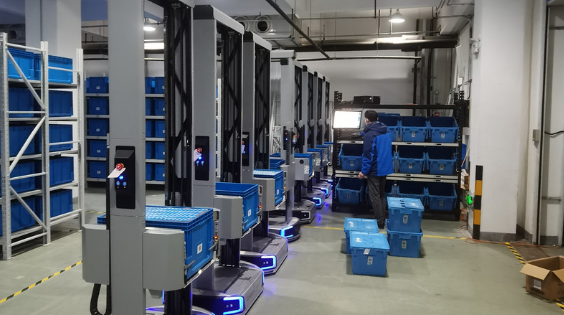
This case study demonstrates how a 33 ACR + 18 AMR automated warehouse system achieves 536 bins per hour throughput, improving overall fulfillment efficiency by up to 300% compared to traditional manual warehouses.
The following breakdown explains how this performance improvement is achieved through system redesign, bottleneck elimination, and intelligent automation architecture.
Technology
- The system integrates advanced warehouse automation technologies:
- 33 ACR autonomous storage robots
- 18 AMR mobile transport robots
- High-density racking system (single + dual-deep)
- Intelligent WMS/WCS control system
- 3D SCADA warehouse visualization platform
- Dynamic task scheduling engine
- Real-time inventory tracking system
- Automated charging system
- Multi-zone buffer architecture
- Conveyor-based sorting and staging systems
Challenge
Traditional warehouses face structural inefficiencies that limit performance regardless of labor size.
Common issues include:
Manual picking delays
Inefficient travel paths for workers
Bottlenecks in sorting and packing zones
High error rates in order processing
Limited scalability of labor-based systems
Unpredictable throughput during peak demand
As order volume increases, these limitations become more severe and costly.
Solution
The ASRS automation system solves these challenges by replacing manual operations with a fully synchronized robotic warehouse ecosystem.
Key improvements include:
Separation of storage and transport functions
Real-time task allocation
Automated bin retrieval and movement
Continuous workflow without human delays
System-level optimization of throughput
This enables stable and scalable warehouse performance.
Workflow & Layout
Step 1: Inbound Processing
Goods are scanned, registered, and assigned system identities.
Step 2: Automated Storage (ACR System)
ACR robots store bins into high-density racks with optimized slot allocation.
Step 3: Intelligent Task Scheduling
WMS dynamically assigns tasks based on:
Order priority
SKU frequency
Warehouse congestion levels
Step 4: Retrieval Operations
ACR retrieves required bins when orders are triggered.
Step 5: AMR Transport Layer
AMR robots transport bins between storage, buffer, and packing zones.
Step 6: Sorting & Fulfillment
Products are grouped, sorted, and prepared for outbound shipment.
Step 7: Dispatch
Finished orders are automatically transferred to shipping docks.
Results & ROI
- 1️⃣ Throughput Performance
- System throughput: 536 bins/hour
- Stable 24/7 operation capability
- 2️⃣ Efficiency Improvement
- Compared to manual warehouse baseline:
- Overall fulfillment efficiency: +300%
- Order processing speed: significantly increased
- Workflow continuity: fully automated
- 3️⃣ Labor Reduction
- Labor dependency reduced by 50–70%
- Fewer operators required for high-volume operations
- 4️⃣ Accuracy Improvement
- Order accuracy up to 99.9%
- Reduced human picking errors
Equipment List
- Core Hardware:
- 33 ACR warehouse robots
- 18 AMR transport robots
- High-density racking system
- Conveyor buffer and sorting modules
- Automated charging stations
- Software Systems:
- WMS (Warehouse Management System)
- WCS (Warehouse Control System)
- SCADA 3D visualization system
- Task scheduling engine
- Real-time inventory tracking system
- Safety & Control Systems:
- Laser safety scanners
- Emergency stop system
- Fleet management controller
- Network communication system
Project Overview / Opening
This project demonstrates how warehouse efficiency is fundamentally determined by system architecture rather than labor scale.
By redesigning warehouse operations around automation, it becomes possible to achieve:
Stable throughput
Continuous operations
Predictable performance scaling
High-density storage utilization
The result is a transformation from labor-intensive operations to intelligent logistics systems.
Key Points
- 1️⃣ Before vs After Efficiency Comparison
- Before (Manual Warehouse):
- Throughput: 120–180 bins/hour (typical)
- High labor dependency
- Frequent bottlenecks
- Variable performance
- After (ACR + AMR System):
- Throughput: 536 bins/hour
- Fully automated operations
- Stable performance
- Scalable architecture
- 2️⃣ Bottleneck Elimination
- Major bottlenecks removed:
- Manual walking time eliminated
- Picking delays reduced
- Storage retrieval optimized
- Transport time minimized
- 3️⃣ Throughput Scaling Logic
- System scalability is achieved through:
- Parallel ACR operation
- Distributed AMR transport network
- Dynamic task scheduling
- Multi-zone workflow design
- This allows throughput to scale without linear labor increase.
- 4️⃣ KPI Improvement Breakdown
- Key KPIs improved:
- Order cycle time: reduced significantly
- Labor efficiency: +200–300%
- Storage utilization: +40–60%
- System uptime: 24/7 capability
- 5️⃣ Why 300% Improvement Is Achievable
- Efficiency gains come from:
- Removal of manual transport delays
- Continuous robotic operation
- Parallel processing capability
- Intelligent warehouse coordination
- 6️⃣ Scalability Advantage
- The system can be expanded by:
- Adding more ACR robots
- Expanding AMR fleet
- Increasing rack density
- Upgrading software logic
- No full system redesign is required.
Implementation / Workflow
Phase 1: Warehouse Analysis (2–3 weeks)
SKU profiling
throughput target definition
bottleneck identification
Phase 2: System Simulation (2–4 weeks)
digital warehouse modeling
throughput simulation (bins/hour)
optimization planning
Phase 3: Engineering Design (4–8 weeks)
robot allocation planning
layout optimization
software architecture design
Phase 4: Installation (2–4 weeks)
system deployment
hardware integration
Phase 5: Commissioning (1–2 weeks)
performance testing
throughput tuning
final optimization
Customer Value / Results
Operational Value:
300%+ efficiency improvement
Faster order fulfillment cycles
Stable warehouse performance
Fully automated operations
Strategic Value:
Scalable logistics infrastructure
Reduced operational risk
Future-ready warehouse system
Improved supply chain reliability
Financial Value:
Lower cost per order
Reduced labor expenses
Faster ROI realization (18–36 months)
Conclusion / Next Step
Achieving 536 bins/hour throughput and 300% efficiency improvement is not simply about adding robots—it is about redesigning the entire warehouse system architecture.
Key success factors include:
✓ ACR + AMR role separation
✓ Bottleneck elimination design
✓ Intelligent task scheduling
✓ Multi-zone workflow optimization
✓ Scalable system architecture
If you are planning to improve warehouse efficiency or design a high-throughput ASRS system, we can help evaluate your current operation and design a customized automation solution.
Related Blog
Start with Your Business Challenge
Tell us about your warehouse, factory, or production requirements. We'll help you explore practical automation solutions and relevant project references.