How to Design a Complete ASRS Warehouse Workflow with AMR, RGV & Stacker Cranes
Summary
Designing an Automated Storage and Retrieval System (ASRS) is no longer just about selecting storage equipment. Modern warehouses require a fully integrated logistics workflow where AMR robots, RGV systems, stacker cranes, conveyors, and warehouse software operate as one intelligent ecosystem.
A well-designed ASRS warehouse must optimize every stage of material flow, from production output and inbound transportation to automated storage, order picking, and outbound delivery. Poor warehouse design often leads to traffic congestion, low equipment utilization, unnecessary investment, and operational bottlenecks that are difficult to correct after installation.
This guide explains how to design a complete ASRS warehouse workflow using AMR, RGV, and stacker crane technology, covering warehouse layout planning, buffer zone configuration, transportation routes, storage architecture, and WMS/WCS integration. It is intended for manufacturing companies, warehouse planners, system integrators, logistics consultants, and engineering teams preparing new warehouse automation projects.
Technology
- A complete ASRS warehouse workflow integrates multiple automation technologies into one coordinated system.
- Intelligent Transportation:
- ① Autonomous Mobile Robots (AMR)
- ② Rail Guided Vehicle (RGV)
- ③ Automatic Conveyor System
- ④ Transfer Stations
- Automated Storage:
- ① High-Rise Stacker Crane ASRS
- ② High-Density Storage Rack
- ③ Intelligent Storage Allocation
- Software Platform:
- ① Warehouse Management System (WMS)
- ② Warehouse Control System (WCS)
- ③ SCADA Visualization Platform
- ④ ERP/MES Integration
- ⑤ Intelligent Task Scheduling Engine
- Smart Technologies:
- ① Barcode & RFID Identification
- ② Dynamic Traffic Management
- ③ Automatic Charging
- ④ Digital Twin Monitoring
- ⑤ Predictive Maintenance
Challenge
Many warehouse automation projects fail to achieve expected performance because the design focuses on equipment selection rather than workflow optimization.
Typical design problems include:
① Production and warehouse operate independently, creating transportation bottlenecks.
② Buffer areas are too small, causing congestion during peak production.
③ AMR traffic intersects with forklift routes, reducing safety and efficiency.
④ RGV transfer lines become overloaded due to poor routing design.
⑤ Stacker crane aisles are improperly configured, limiting storage capacity.
⑥ WMS and WCS are implemented late, resulting in poor system coordination.
Correcting these issues after construction is expensive and often requires operational disruption.
Solution
The most successful ASRS projects begin with workflow design rather than equipment selection.
Instead of asking "Which robot should we buy?", engineers should first ask:
① How do materials flow through the facility?
② Where do delays occur?
③ Which operations require flexibility?
④ Which operations require maximum throughput?
⑤ How should software coordinate all equipment?
Once these questions are answered, AMRs, RGVs, stacker cranes, and software can be configured into a synchronized automation architecture that maximizes efficiency while supporting future expansion.
Workflow & Layout
1. Warehouse Layout Planning
Warehouse layout determines long-term operational efficiency.
A typical intelligent warehouse is divided into functional zones:
Production Area
Inbound Receiving
Quality Inspection
Buffer Zone
High-Density Storage
Picking Area
Packing Area
Outbound Shipping
Empty Pallet Area
Equipment Maintenance Zone
Each zone should minimize unnecessary transportation while maintaining smooth material flow.
2. Production → Warehouse Connection
Finished products should move automatically from production lines into warehouse operations.
Typical workflow:
Production Line
↓
Automatic Identification
↓
AMR Pickup
↓
Buffer Area
↓
RGV Transfer
↓
Stacker Crane Storage
This eliminates forklift transportation and reduces production interruptions.
3. Buffer Zone Design
The buffer area acts as the transition point between flexible transportation and high-speed storage.
Its functions include:
① Temporary material accumulation
② Production rhythm balancing
③ Traffic separation
④ Task scheduling
⑤ Order sequencing
A properly designed buffer prevents production downtime while maximizing crane utilization.
4. AMR Warehouse Layout
AMRs are responsible for flexible transportation.
Design considerations include:
① Travel distance optimization
② One-way traffic routes
③ Charging station locations
④ Emergency bypass paths
⑤ Collision avoidance zones
⑥ Future robot expansion
The objective is to minimize travel time while maintaining safe, uninterrupted movement.
5. RGV Routing Design
RGV systems provide fast and repeatable transportation between warehouse zones.
Best practices include:
① Straight transportation corridors
② Dedicated transfer lanes
③ Buffer synchronization
④ High-speed shuttle operation
⑤ Parallel routing where throughput is high
RGVs are most effective when assigned predictable, repetitive transportation tasks.
6. Stacker Crane Layout
Stacker cranes determine the warehouse's storage density and retrieval efficiency.
Key design parameters include:
① Rack height
② Aisle width
③ Number of crane aisles
④ Storage location allocation
⑤ Double-deep or single-deep storage
⑥ Expansion capability
Proper crane layout balances storage capacity with retrieval speed.
7. WMS & WCS Integration
Software is the intelligence layer connecting every subsystem.
The integration workflow typically follows:
ERP
↓
MES (optional)
↓
WMS
↓
WCS
↓
PLC
↓
AMR / RGV / Crane
↓
SCADA Monitoring
Real-time communication allows automatic task assignment, inventory synchronization, and equipment coordination.
Results & ROI
- ① Higher Throughput
- An optimized workflow minimizes waiting time between production
- transportation
- and storage
- significantly increasing warehouse throughput.
- ② Better Space Utilization
- Integrated layout planning enables high-density storage while maintaining fast access to inventory.
- ③ Reduced Equipment Idle Time
- Balanced workflows ensure AMRs
- RGVs
- and stacker cranes operate continuously rather than waiting for downstream processes.
- ④ Lower Labor Requirements
- Automated transportation and storage reduce manual handling
- forklift traffic
- and repetitive labor.
- ⑤ Faster Return on Investment
- Well-designed ASRS systems typically achieve ROI within 18–36 months through labor savings
- increased productivity
- and improved inventory accuracy.
Equipment List
- Material Handling:
- ① AMR Robots
- ② RGV Shuttle System
- ③ Roller Conveyors
- ④ Transfer Stations
- Storage Equipment:
- ① High-Rise Storage Racks
- ② Stacker Crane ASRS
- ③ Buffer Storage Modules
- Software:
- ① WMS
- ② WCS
- ③ SCADA
- ④ ERP Interface
- ⑤ MES Interface (Optional)
- Safety:
- ① Safety PLC
- ② Laser Scanners
- ③ Light Curtains
- ④ Emergency Stop Devices
- ⑤ Fire Protection Interface
Project Overview / Opening
A complete ASRS warehouse is not built by combining robots and storage racks. It is engineered through intelligent workflow planning that synchronizes transportation, storage, inventory management, and software control.
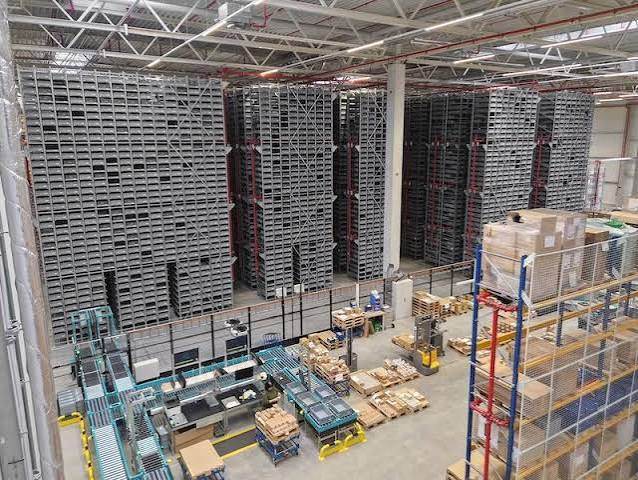
In this project, AMRs provide flexible movement from production to warehouse, RGV systems ensure high-speed material transfer across functional zones, and stacker cranes deliver high-density automated storage and retrieval. WMS and WCS coordinate every operation in real time, creating a warehouse capable of supporting continuous manufacturing and high-volume logistics.
This design philosophy enables companies to improve productivity today while creating a scalable automation platform for future business growth.
Key Points
- ① Start with Material Flow, Not Equipment
- Warehouse design should begin by analyzing product movement rather than selecting robots or cranes.
- ② Separate Flexible and High-Speed Transportation
- AMRs handle dynamic routes, while RGVs manage fixed, high-frequency transfers. Assigning each technology to its strengths improves efficiency and system stability.
- ③ Buffer Zones Are Critical
- A well-designed buffer absorbs fluctuations between production and storage, preventing bottlenecks and maximizing equipment utilization.
- ④ Software Determines Overall Performance
- WMS and WCS orchestrate every movement, ensuring that transportation, storage, and retrieval operate as one coordinated process.
- ⑤ Design for Expansion
- Choose modular layouts that allow additional robots, cranes, storage aisles, and workstations to be added without redesigning the entire warehouse.
Implementation / Workflow
Phase ① Operational Analysis (1–2 Weeks)
Evaluate production rates, SKU profiles, inventory turnover, and throughput requirements.
Phase ② Conceptual Layout Design (2–3 Weeks)
Develop warehouse zoning, transportation routes, rack configuration, and equipment allocation.
Phase ③ Detailed Engineering (3–5 Weeks)
Finalize structural drawings, control architecture, software interfaces, and safety systems.
Phase ④ Equipment Installation & Integration (6–12 Weeks)
Install AMRs, RGVs, stacker cranes, conveyors, racks, and warehouse software.
Phase ⑤ Commissioning & Optimization (2–4 Weeks)
Conduct system testing, operator training, throughput validation, and workflow optimization before full production.
Customer Value / Results
Operational Value:
① Smooth end-to-end material flow
② Higher storage density
③ Increased throughput
④ Stable 24/7 operation
⑤ Reduced warehouse congestion
Financial Value:
① Lower labor costs
② Reduced forklift investment
③ Faster inventory turnover
④ Lower operating expenses
⑤ Shorter project payback period
Strategic Value:
① Scalable warehouse architecture
② Digital factory integration
③ Future-ready logistics platform
④ Greater supply chain resilience
⑤ Enhanced competitiveness in high-growth markets
Conclusion / Next Step
Designing a successful ASRS warehouse is about much more than choosing automation equipment. It requires a comprehensive understanding of material flow, warehouse layout, transportation strategy, storage architecture, and software integration.
By combining AMR robots for flexible transportation, RGV systems for high-speed transfers, stacker cranes for high-density storage, and WMS/WCS for intelligent control, companies can build a warehouse that is efficient, scalable, and prepared for future operational demands.
Whether you are planning a new manufacturing facility, expanding a distribution center, or modernizing an existing warehouse, investing in a well-engineered workflow from the beginning will deliver higher throughput, lower operating costs, and stronger long-term returns.
Our engineering team can provide warehouse layout planning, throughput simulation, equipment selection, workflow optimization, and complete turnkey ASRS design services, helping you develop an automation solution tailored to your products, operational goals, and future growth strategy.
Related Blog
Start with Your Business Challenge
Tell us about your warehouse, factory, or production requirements. We'll help you explore practical automation solutions and relevant project references.