5 Common Packaging Problems Pharmaceutical Companies Face and How Automation Solves Them
Summary
Pharmaceutical manufacturers operate in highly regulated environments where packaging accuracy, product traceability, and production efficiency directly affect business performance.
However, many facilities still experience packaging bottlenecks that increase operating costs and reduce productivity.
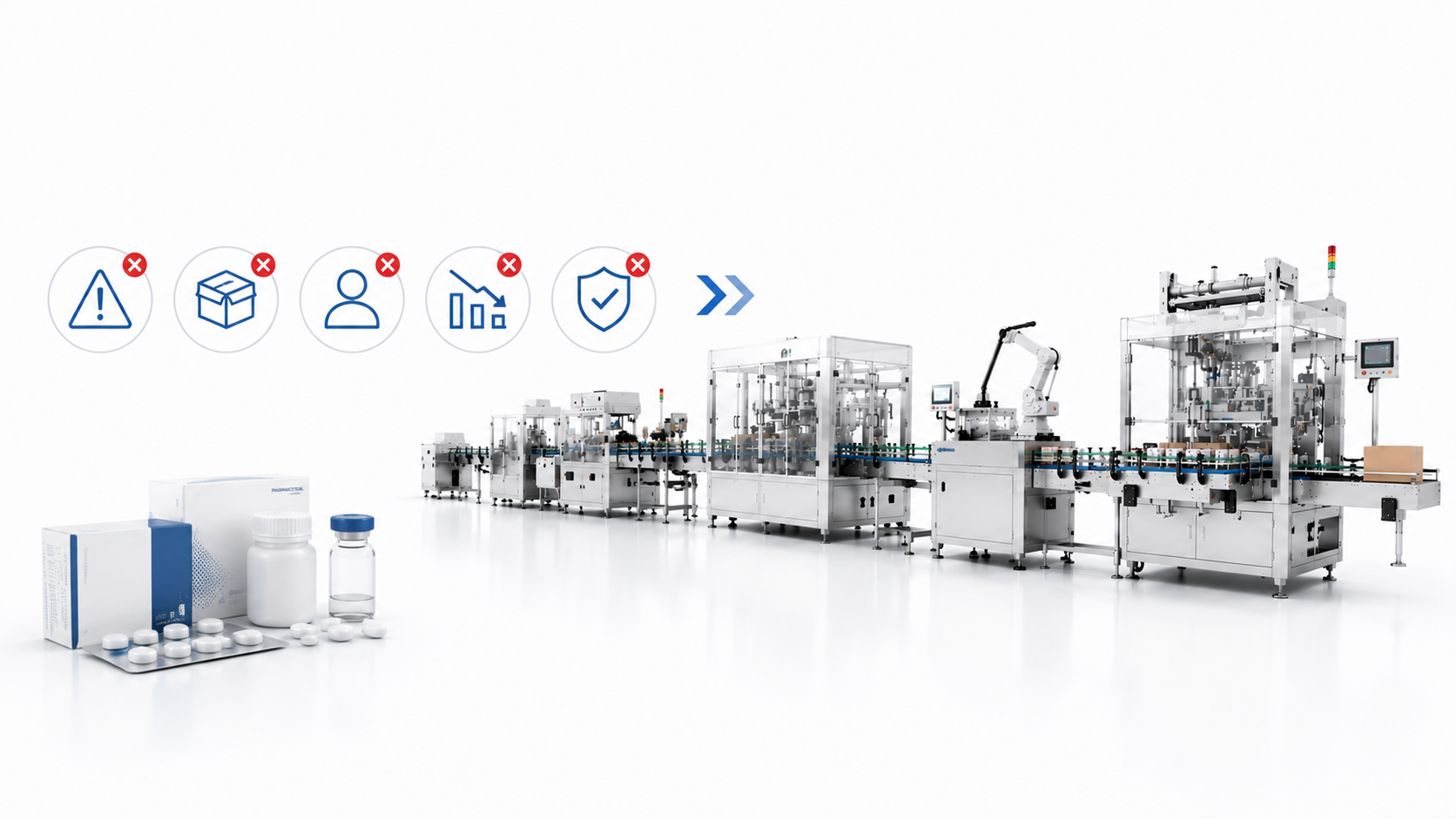
In this guide, we examine five of the most common pharmaceutical packaging problems and explain how packaging automation systems help solve them.
Technology
- Technologies commonly used in pharmaceutical packaging automation:
- Automatic Product Feeding System
- Servo Cartoning Machine
- Product Grouping Conveyor
- Automatic Case Packing System
- Vision Inspection System
- Barcode Verification
- Serialization System
- PLC Control System
- HMI Interface
- Robotic Pick-and-Place
- MES / ERP Integration
Challenge
Pharmaceutical packaging systems must maintain:
Product safety
Regulatory compliance
Packaging consistency
Traceability
Production efficiency
However, many manufacturers face operational challenges that gradually reduce productivity and increase cost.
Without workflow optimization, packaging departments often become major production bottlenecks.
Solution
Automation integrates multiple packaging operations into one synchronized system.
Instead of relying heavily on manual operations, manufacturers can improve process stability and reduce packaging risks.
Automation advantages include:
Reduced labor dependency
Better production consistency
Higher throughput
Reduced human errors
Improved product tracking
Easier future expansion
Workflow & Layout
Typical pharmaceutical packaging workflow:
Product Input
↓
Primary Packaging
↓
Inspection & Verification
↓
Automatic Cartoning
↓
Serialization
↓
Product Grouping
↓
Automatic Case Packing
↓
Finished Product Output
Layout recommendations:
Straight product flow
Reduced material movement
Clean area separation
Expansion space for future production
Results & ROI
- Typical operational improvements:
- Labor reduction:
- 40–65%
- Packaging speed improvement:
- 30–70%
- Packaging error reduction:
- 50–90%
- Packaging consistency:
- Significantly improved
- Estimated ROI:
- 12–24 months
Equipment List
- Typical system configuration:
- Product Feeding Unit
- Automatic Cartoning Machine
- Conveyor System
- Product Inspection Unit
- Serialization System
- Product Grouping Unit
- Automatic Case Packer
- PLC Control Cabinet
- HMI Interface
- Safety Protection System
- Optional systems:
- Vision Detection
- Robot Pick-and-Place
- AGV Material Handling
- MES Integration
Project Overview / Opening
Packaging operations are often underestimated when manufacturers evaluate production performance.
Many companies focus on production equipment while overlooking packaging bottlenecks that gradually reduce efficiency and increase costs.
Modern pharmaceutical packaging systems increasingly use automation as a strategic solution rather than simply replacing labor.
Key Points
- Problem 1: High Labor Costs
- Typical issue:
- Manual packaging processes often require large operator teams.
- Impact:
- Higher operating cost
- Labor shortages
- High employee turnover
- Automation solution:
- Automatic cartoning and case packing systems reduce repetitive labor tasks.
- Expected result:
- 40–70% labor reduction
- Problem 2: Packaging Errors
- Typical issue:
- Human operations may create:
- Missing products
- Incorrect inserts
- Label errors
- Incorrect packaging quantities
- Impact:
- Product waste
- Rework cost
- Customer complaints
- Automation solution:
- Vision inspection and barcode verification systems automatically detect errors.
- Expected result:
- 50–90% fewer packaging defects
- Problem 3: Production Bottlenecks
- Typical issue:
- Manual operations frequently limit line speed.
- Impact:
- Reduced throughput
- Delayed delivery schedules
- Automation solution:
- Integrated cartoning and case packing systems synchronize production flow.
- Expected result:
- 30–80% efficiency improvement
- Problem 4: Poor Product Traceability
- Typical issue:
- Manual tracking systems create information gaps.
- Impact:
- Difficult recall management
- Compliance risk
- Automation solution:
- Serialization and MES integration provide real-time tracking.
- Expected result:
- Improved traceability visibility
- Problem 5: Difficult Future Expansion
- Typical issue:
- Standalone equipment often creates expansion limitations.
- Impact:
- Expensive future upgrades
- Operational disruption
- Automation solution:
- Modular system design allows future capacity expansion.
- Expected result:
- Higher production flexibility
Implementation / Workflow
Typical project process:
Phase 1
Production evaluation
Duration:
1–2 weeks
Phase 2
Packaging system design
Duration:
2–3 weeks
Phase 3
Equipment manufacturing
Duration:
4–8 weeks
Phase 4
Factory Acceptance Test
Duration:
1 week
Phase 5
Installation and commissioning
Duration:
2–4 weeks
Estimated complete delivery cycle:
8–16 weeks
Customer Value / Results
Operational benefits:
Reduced packaging costs
Improved production speed
Better packaging quality
Reduced downtime
Lower human error risk
Strategic benefits:
Easier compliance management
Improved future scalability
Higher manufacturing competitiveness
Financial benefits:
Lower cost per package
Reduced operating expenses
Faster return on investment
Conclusion / Next Step
Most pharmaceutical packaging problems are not caused by individual machines.
They are usually caused by disconnected workflows and inefficient processes.
Before investing in equipment, manufacturers should evaluate:
✓ Production bottlenecks
✓ Packaging requirements
✓ Compliance requirements
✓ Future expansion needs
✓ Expected ROI
A well-designed packaging automation system helps manufacturers improve efficiency while reducing operational risk.
If you are planning a pharmaceutical packaging project, we can help identify bottlenecks and design a suitable packaging solution.
Related Blog
Start with Your Business Challenge
Tell us about your warehouse, factory, or production requirements. We'll help you explore practical automation solutions and relevant project references.