Manual Packaging vs Automated Cartoning Systems: Which Saves More Money?
Summary
Many manufacturers planning production upgrades ask the same question:
Should we continue using manual packaging, or invest in automated cartoning systems?
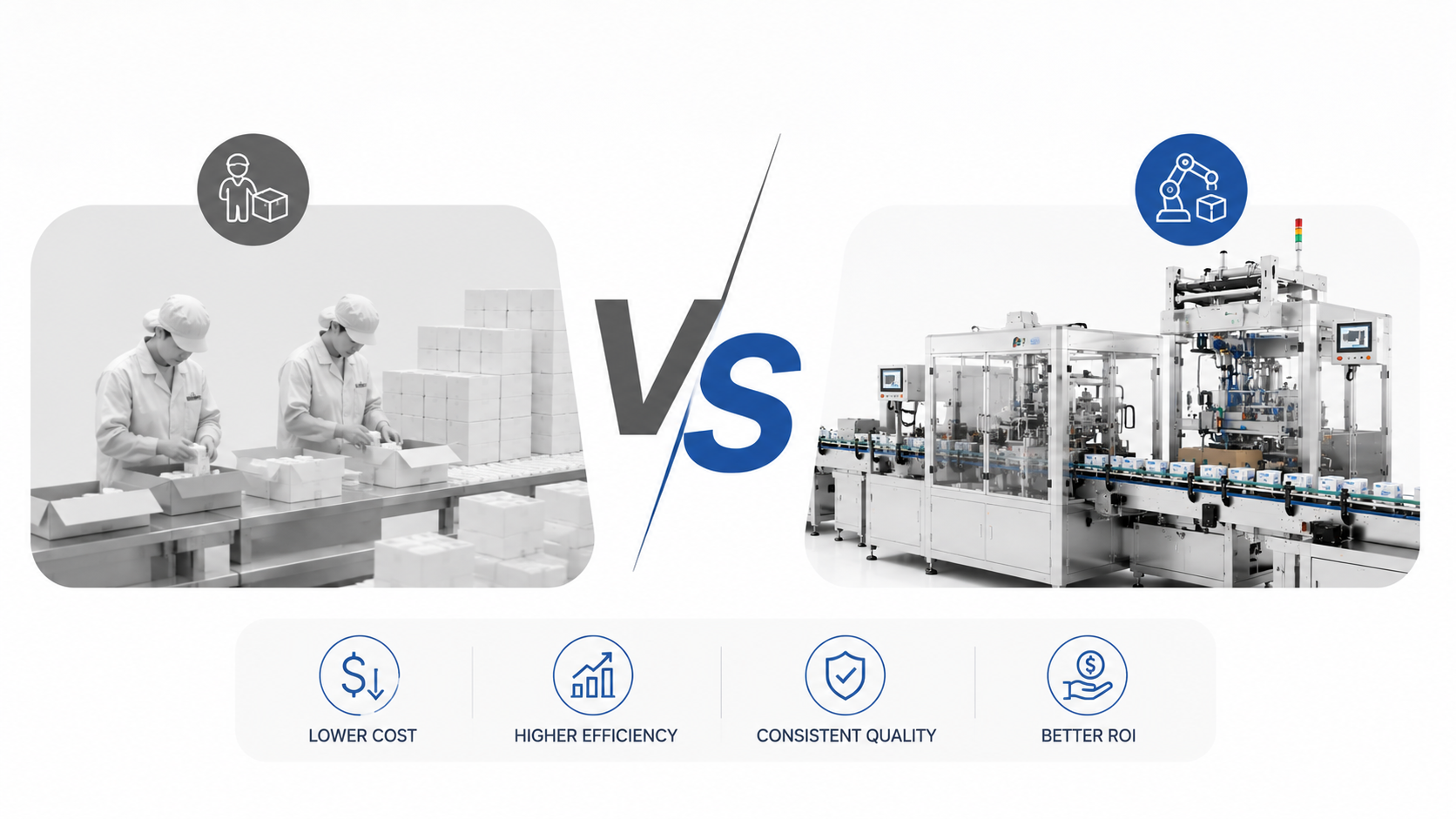
Manual operations may appear less expensive at the beginning because of lower equipment investment. However, labor costs, quality variation, production limitations, and operational inefficiencies often create much higher long-term costs.
This guide compares manual packaging and automated cartoning systems based on investment, operating cost, productivity, labor requirements, and return on investment.
Technology
- Technologies commonly used in automated cartoning systems:
- Automatic Product Feeding
- Servo Cartoning Machine
- Intelligent Product Grouping
- Conveyor Integration
- PLC Control System
- HMI Touchscreen Interface
- Vision Inspection System
- Barcode Verification
- Robotic Pick-and-Place
- MES / ERP Integration
Challenge
Many manufacturers initially choose manual packaging because the upfront investment appears lower.
However, growing operations often create several problems:
Rising labor costs
Human packaging errors
Production bottlenecks
Inconsistent packaging quality
High employee turnover
Increased training requirements
Limited scalability
Production delays during peak seasons
As production volume increases, manual systems often become operational constraints.
Solution
Automated cartoning systems replace repetitive manual tasks with synchronized machine operations.
Instead of increasing workforce size as production grows, manufacturers can improve capacity through automation.
Main automation advantages:
Reduced labor dependency
Stable packaging quality
Faster production speed
Lower operational risk
Better production planning
Easier future expansion
Workflow & Layout
Manual Packaging Workflow
Product Input
↓
Manual Product Handling
↓
Manual Carton Assembly
↓
Manual Product Insertion
↓
Manual Inspection
↓
Case Packing
↓
Finished Product Output
Automated Packaging Workflow
Product Feeding
↓
Automatic Cartoning
↓
Product Inspection
↓
Grouping Conveyor
↓
Automatic Case Packing
↓
Finished Product Output
Typical layout advantages of automation:
Linear material flow
Reduced operator movement
Lower floor space requirements
Easier maintenance access
Results & ROI
- Typical operational improvements after automation:
- Labor reduction:
- 40–70%
- Packaging speed improvement:
- 30–80%
- Packaging consistency:
- Significantly improved
- Error reduction:
- 50–90%
- Estimated ROI:
- 12–24 months
Equipment List
- Manual packaging setup:
- Packaging tables
- Manual sealing tools
- Labeling devices
- Manual inspection stations
- Automated packaging setup:
- Product Feeding System
- Automatic Cartoning Machine
- Conveyor System
- Inspection Unit
- Product Grouping Conveyor
- Automatic Case Packer
- PLC Control System
- HMI Panel
- Safety Protection System
- Optional:
- Vision Inspection
- Barcode Verification
- Robot Pick-and-Place
Project Overview / Opening
Manual packaging systems have supported manufacturing operations for many years.
But increasing labor costs and higher production requirements are changing investment decisions.
Today, manufacturers are increasingly evaluating whether automated systems can reduce operating costs while supporting future business growth.
Key Points
- Initial Investment Comparison
- Manual packaging:
- USD 10,000–50,000
- Automated cartoning:
- USD 80,000–300,000+
- Labor Requirements
- Manual packaging:
- 6–15 operators
- Automated packaging:
- 1–3 operators
- Production Capacity
- Manual packaging:
- 20–60 cartons/min
- Automated packaging:
- 80–400 cartons/min
- Error Rate
- Manual packaging:
- Higher variation
- Automated packaging:
- Stable and repeatable
- Scalability
- Manual packaging:
- Limited
- Automated packaging:
- High
Implementation / Workflow
Typical automation project process:
Phase 1
Production requirement analysis
Duration:
1–2 weeks
Phase 2
Packaging system design
Duration:
1–3 weeks
Phase 3
Equipment manufacturing
Duration:
4–8 weeks
Phase 4
Factory Acceptance Test
Duration:
1 week
Phase 5
Installation and commissioning
Duration:
2–4 weeks
Estimated complete project cycle:
8–16 weeks
Customer Value / Results
Financial benefits:
Reduced labor costs
Lower packaging cost per product
Faster production output
Reduced operational risk
Improved production planning
Operational benefits:
Better product consistency
Reduced downtime
Higher packaging accuracy
Easier workforce management
Strategic benefits:
Easier expansion
Better competitiveness
Faster future scaling
Conclusion / Next Step
Manual packaging may have a lower initial investment, but long-term operating costs often increase significantly as production grows.
Automated cartoning systems typically require higher upfront investment but can create:
✓ Lower labor costs
✓ Higher production efficiency
✓ Better packaging quality
✓ Lower operational risk
✓ Faster long-term ROI
The right decision depends on production volume, labor costs, future growth plans, and expected return on investment.
If you are planning a packaging automation upgrade, we can help you design the system and estimate your investment requirements.
Related Blog
Start with Your Business Challenge
Tell us about your warehouse, factory, or production requirements. We'll help you explore practical automation solutions and relevant project references.