Can an Automatic Cartoning Line Reduce Labor Costs by 50%?
Summary
Reducing labor costs has become one of the biggest challenges for pharmaceutical, beauty, healthcare, and consumer product manufacturers.
As labor expenses continue to increase worldwide, many companies are evaluating whether packaging automation can significantly lower operational costs.
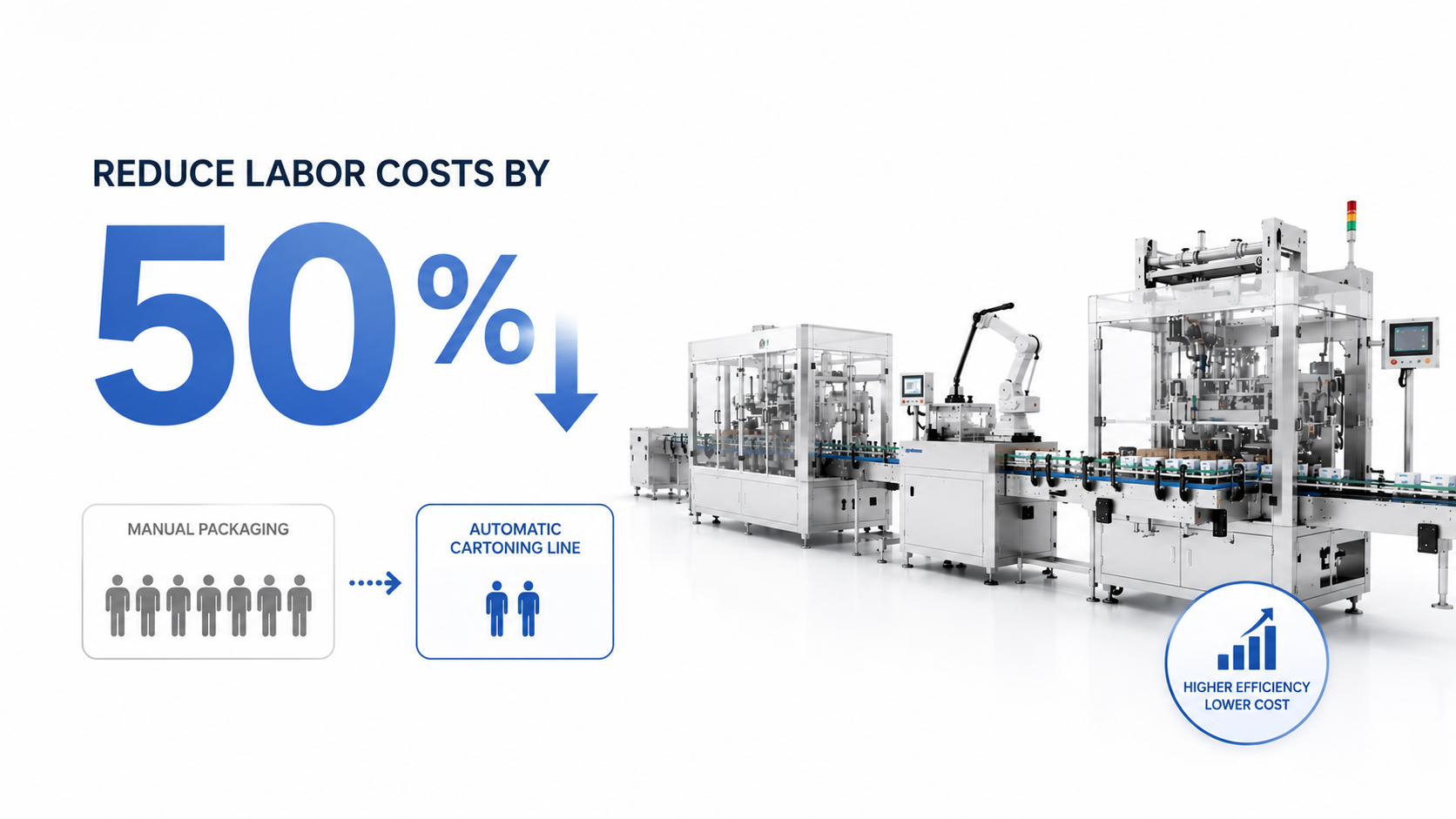
But can an automatic cartoning line really reduce labor costs by 50% or more?
The answer depends on production volume, labor structure, packaging complexity, and automation level.
In this guide, we break down where labor savings come from, how ROI is calculated, and when packaging automation becomes financially worthwhile.
Technology
- Technologies commonly used in automatic cartoning systems:
- Automatic Product Feeding System
- Servo Cartoning Machine
- Product Grouping Conveyor
- Automatic Case Packing System
- PLC Control System
- HMI Touchscreen Interface
- Barcode Verification
- Vision Inspection
- Robotic Pick-and-Place
- MES / ERP Integration
Challenge
Manufacturers relying on manual packaging often face increasing operational pressure.
Typical challenges include:
Rising labor expenses
Worker shortages
Human packaging errors
High turnover rates
Seasonal labor instability
Training costs
Inconsistent productivity
Limited production scalability
As production volume increases, labor costs often grow faster than output.
Solution
Automatic cartoning systems reduce repetitive manual work by replacing labor-intensive packaging operations with synchronized machine processes.
Instead of adding more workers to increase production, manufacturers improve capacity through automation.
Typical labor reduction areas:
Product feeding
Carton assembly
Product insertion
Product grouping
Inspection
Case packing
Material handling
Main benefits include:
Reduced labor dependency
Stable production output
Lower operational risk
Better packaging consistency
Easier expansion
Workflow & Layout
Traditional Manual Packaging
Product Input
↓
Manual Sorting
↓
Manual Carton Folding
↓
Manual Product Insertion
↓
Manual Inspection
↓
Case Packing
↓
Finished Product Output
Automatic Packaging Workflow
Product Feeding
↓
Automatic Cartoning
↓
Inspection System
↓
Product Grouping
↓
Automatic Case Packing
↓
Finished Product Output
Layout advantages:
Reduced operator movement
Compact production footprint
Better material flow
Easier maintenance access
Results & ROI
- Typical estimated improvements after automation:
- Labor cost reduction:
- 40–70%
- Packaging efficiency increase:
- 30–80%
- Packaging consistency:
- Significantly improved
- Packaging errors:
- Reduced by 50–90%
- Estimated ROI:
- 12–24 months
Equipment List
- Typical automatic cartoning line configuration:
- Product Feeding Unit
- Automatic Cartoning Machine
- Conveyor System
- Product Inspection Unit
- Product Grouping System
- Automatic Case Packer
- Control Cabinet
- HMI System
- Safety Protection Devices
- Optional systems:
- Robot Pick-and-Place
- Vision Inspection
- Barcode Verification
- MES Integration
Project Overview / Opening
For many manufacturers, labor expenses are becoming one of the largest operating costs.
Packaging automation is increasingly viewed not simply as equipment investment, but as a long-term cost reduction strategy.
The question is no longer:
"Should we automate?"
More companies are asking:
"When should we automate?"
Key Points
- Example Labor Comparison
- Manual Packaging Line:
- Operators required:
- 10–15 workers
- Annual labor cost:
- USD 150,000–300,000
- Automatic Cartoning Line:
- Operators required:
- 2–4 workers
- Annual labor cost:
- USD 40,000–100,000
- Estimated annual labor savings:
- USD 80,000–200,000+
- Factors Affecting Savings
- Production volume
- Higher volume generally creates faster ROI.
- Local labor cost
- Markets with higher labor expenses usually see stronger savings.
- Product complexity
- Complex packaging often benefits more from automation.
- Production schedule
- Multiple shifts increase labor reduction benefits.
Implementation / Workflow
Typical project implementation process:
Phase 1
Production analysis
1–2 weeks
Phase 2
System design
1–3 weeks
Phase 3
Equipment manufacturing
4–8 weeks
Phase 4
Factory testing
1 week
Phase 5
Installation and commissioning
2–4 weeks
Estimated complete cycle:
8–16 weeks
Customer Value / Results
Financial benefits:
Reduced labor expenses
Lower packaging cost per unit
Faster investment recovery
Lower overtime expenses
Operational benefits:
Increased production output
Stable packaging quality
Reduced human errors
Better production planning
Strategic benefits:
Easier future scaling
Reduced dependence on labor availability
Improved manufacturing competitiveness
Conclusion / Next Step
Can automatic cartoning lines reduce labor costs by 50%?
For many manufacturers, the answer is yes—and sometimes significantly more.
However, actual results depend on:
✓ Production volume
✓ Labor costs
✓ Product type
✓ Packaging complexity
✓ Automation level
✓ Long-term business goals
The right automation strategy focuses not only on labor savings, but also on improving productivity and future growth capacity.
If you are planning a packaging automation project, we can help estimate your expected labor savings and ROI.
Related Blog
Start with Your Business Challenge
Tell us about your warehouse, factory, or production requirements. We'll help you explore practical automation solutions and relevant project references.