Complete Cartoning and Case Packing Workflow Explained Step by Step
Summary
A complete cartoning and case packing line combines multiple packaging processes into one automated workflow.
Many manufacturers understand the benefits of packaging automation but are less familiar with how the entire process actually works.
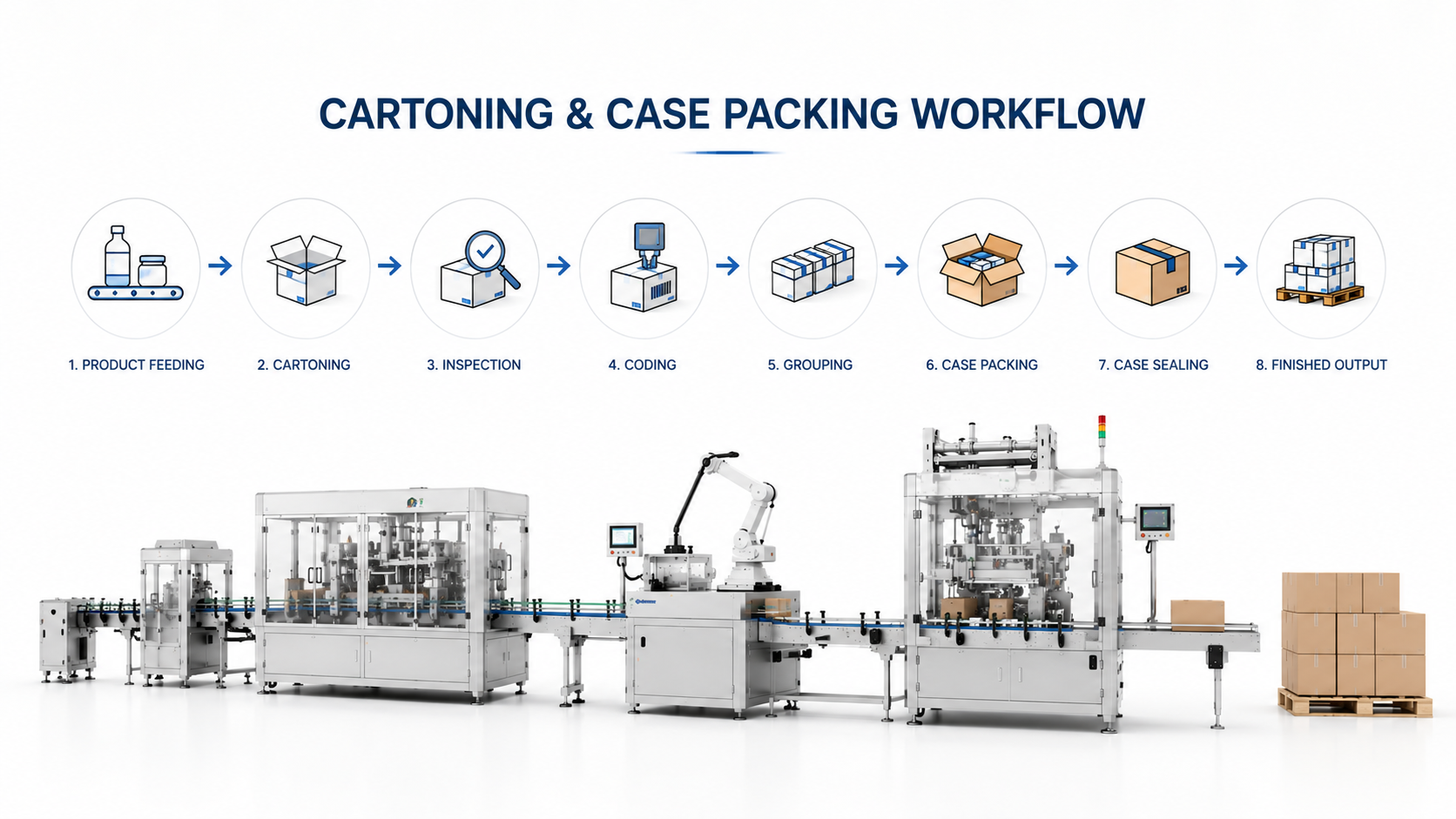
This guide explains each stage of the packaging workflow step by step, from product feeding to finished case output.
Whether you work in pharmaceutical, cosmetic, healthcare, or consumer goods manufacturing, understanding the workflow helps improve system planning and investment decisions.
Technology
- Technologies commonly used in complete packaging systems:
- Automatic Product Feeding
- Servo Cartoning Machine
- Intelligent Conveyor Integration
- Product Grouping System
- Automatic Case Packing System
- PLC Control System
- HMI Interface
- Barcode Verification
- Vision Inspection System
- Robotic Pick-and-Place
- MES / ERP Integration
Challenge
Many manufacturers experience production inefficiencies because they do not fully understand how packaging processes interact.
Typical challenges include:
Production bottlenecks
Product handling errors
Packaging inconsistency
Excessive labor requirements
Workflow interruptions
Poor line balancing
Future expansion limitations
Disconnected packaging equipment frequently causes operational inefficiency.
Solution
A complete automated cartoning and case packing line integrates multiple operations into one synchronized process.
Instead of treating equipment as independent machines, the entire production flow operates as one system.
Advantages include:
Stable product flow
Reduced manual handling
Higher production speed
Better packaging consistency
Reduced downtime
Easier scalability
Workflow & Layout
Step 1: Product Feeding
Products enter the production line through an automatic feeding system.
Functions:
Product orientation
Product spacing
Product transfer
Purpose:
Ensure stable product supply.
Step 2: Carton Forming
Flat cartons are automatically opened and formed.
Functions:
Carton opening
Shape verification
Position control
Purpose:
Prepare packaging structure.
Step 3: Product Insertion
Products are automatically inserted into cartons.
Functions:
Product positioning
Synchronized motion control
Accurate insertion
Purpose:
Maintain packaging accuracy.
Step 4: Carton Closing
Cartons are sealed after product insertion.
Functions:
Folding
Glue sealing
Locking mechanisms
Purpose:
Secure product packaging.
Step 5: Product Inspection
Inspection systems verify packaging quality.
Functions:
Barcode verification
Product presence detection
Vision inspection
Purpose:
Reduce packaging defects.
Step 6: Product Grouping
Individual products are automatically grouped before case packing.
Functions:
Product counting
Product arrangement
Synchronization
Purpose:
Prepare products for final packing.
Step 7: Automatic Case Packing
Grouped products enter shipping cases automatically.
Functions:
Pick and place
Product loading
Case positioning
Purpose:
Reduce manual handling.
Step 8: Case Sealing & Output
Finished shipping cases are sealed and transferred to logistics areas.
Functions:
Carton sealing
Labeling
Output transfer
Purpose:
Prepare products for storage and shipping.
Results & ROI
- Typical packaging improvements:
- Labor reduction:
- 40–70%
- Packaging efficiency increase:
- 30–80%
- Packaging quality consistency:
- Significantly improved
- Error reduction:
- 50–90%
- Estimated ROI:
- 12–24 months
Equipment List
- Typical packaging line components:
- Product Feeding Unit
- Automatic Cartoning Machine
- Product Conveyor System
- Inspection System
- Product Grouping Unit
- Automatic Case Packer
- Case Sealer
- PLC Control Cabinet
- HMI System
- Safety Protection System
- Optional systems:
- Vision Detection
- Robot Handling Unit
- Barcode Verification
- MES Integration
Project Overview / Opening
Packaging automation has evolved beyond standalone machines.
Modern manufacturing increasingly requires integrated systems that improve production efficiency while reducing labor costs and operational risk.
Understanding workflow structure becomes essential before investing in packaging equipment.
Key Points
- Complete Packaging Workflow Summary
- Product Feeding
- ↓
- Carton Forming
- ↓
- Product Insertion
- ↓
- Carton Closing
- ↓
- Inspection
- ↓
- Product Grouping
- ↓
- Case Packing
- ↓
- Case Sealing
- ↓
- Finished Product Output
- Typical production capacity:
- Low speed:
- 30–60 cartons/min
- Medium speed:
- 80–150 cartons/min
- High speed:
- 200–400+ cartons/min
- Applications:
- Pharmaceuticals
- Cosmetics
- Healthcare products
- Daily care products
- Consumer goods
Implementation / Workflow
Typical project process:
Phase 1
Requirement analysis
Duration:
1–2 weeks
Phase 2
Workflow design
Duration:
2–3 weeks
Phase 3
Equipment manufacturing
Duration:
4–8 weeks
Phase 4
Factory testing
Duration:
1 week
Phase 5
Installation and commissioning
Duration:
2–4 weeks
Estimated complete delivery cycle:
8–16 weeks
Customer Value / Results
Operational benefits:
Higher production speed
Lower labor costs
Reduced product handling errors
Better packaging consistency
Improved line stability
Strategic benefits:
Easier future expansion
Lower operational risk
Better production planning
Higher manufacturing flexibility
Financial benefits:
Lower cost per product
Faster ROI
Increased output capability
Conclusion / Next Step
Understanding the complete cartoning and case packing workflow helps manufacturers make better investment decisions.
Rather than selecting equipment individually, companies should focus on designing integrated production systems.
Before selecting a packaging solution, manufacturers should evaluate:
✓ Product type
✓ Production capacity
✓ Factory layout
✓ Automation level
✓ Future growth plans
✓ Expected ROI
If you are planning a packaging automation project, we can help design a complete packaging workflow tailored to your production requirements.
Related Blog
Start with Your Business Challenge
Tell us about your warehouse, factory, or production requirements. We'll help you explore practical automation solutions and relevant project references.